Ruby receptionist pricing: every plan, priced at your call volume
On 23 November 2026, we reviewed Ruby’s pricing page, its billing help articles, and its terms of use; we recorded the plan tables and calculated the cost of each plan at 25 to 300 calls per month, including the way Ruby rounds each call and the points at which the next higher plan is cheaper.
How we checked. On 23 November 2026, we reviewed Ruby’s plans and pricing page, along with six help center articles, its FAQ, and its terms of use, and we recorded the two plan tables displayed below. We did not create an account. All monthly costs shown on this page are our calculations based on the prices Ruby publishes. Ruby did not sponsor this page and did not review it before it was published.
- Receptionist plans
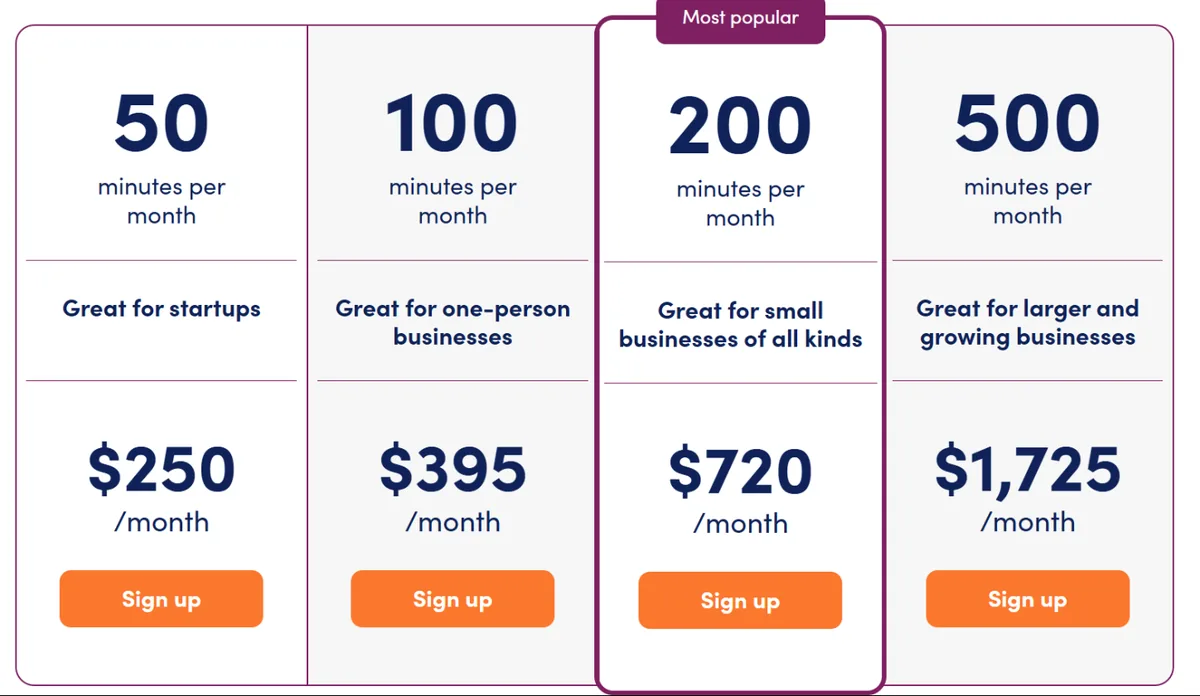
- $250 for 50 minutes, $395 for 100, $720 for 200, and $1,725 for 500 on the pricing page; the help center lists plans ranging from 350 to 2,500 minutes
- Extra minutes
- $3.30 per minute to $5.40 per minute, with lower rates on larger plans
- Billing
- Receptionist minutes, with each call rounded up to the next full minute; hold time and post-call work are included
- Setup
- No fees for activation, onboarding, setup or customization, and no surcharge for coverage during particular periods
- Contract
- The subscription renews automatically every 30 days; to stop it, cancel before the next billing date.
- Guarantee
- First-time customers receive a complete refund if they cancel within 21 days or before they use 500 receptionist minutes, whichever occurs earlier.
- Payment
- Credit card payments incur a 3% surcharge; debit cards, ACH, and checks are not subject to any surcharge.
- Checked
- 23 November 2026
Ruby’s receptionist plans
Ruby offers its live receptionist service on a per-minute basis. On the pricing page, four options are shown: 50 receptionist minutes each month for $250, 100 for $395, 200 for $720, and 500 for $1,725. The 200-minute option is labeled the most popular. All plans include identical features; according to Ruby, the sole variation among them is how many receptionist minutes are included.
Ruby’s help center provides the complete lineup: ten plans, ranging from Call Ruby 50 through Call Ruby 2,500, and each one has a separate charge for minutes beyond the allowance. The table also shows the effective cost of an included minute for every plan. As the plan size increases, both prices go down: an included minute is $5.00 on Call Ruby 50 and $3.15 on Call Ruby 2,500.
| Plan | Price | Per minute | Extra minute |
|---|---|---|---|
| Call Ruby 50 | $250 | $5.00 | $5.40 |
| Call Ruby 100 | $395 | $3.95 | $4.50 |
| Call Ruby 200 | $720 | $3.60 | $4.40 |
| Call Ruby 350 | $1,210 | $3.46 | $4.25 |
| Call Ruby 500 | $1,725 | $3.45 | $4.00 |
| Call Ruby 750 | $2,550 | $3.40 | $3.85 |
| Call Ruby 1,000 | $3,350 | $3.35 | $3.65 |
| Call Ruby 1,500 | $4,945 | $3.30 | $3.50 |
| Call Ruby 2,000 | $6,400 | $3.20 | $3.40 |
| Call Ruby 2,500 | $7,875 | $3.15 | $3.30 |
Price is charged monthly. Per minute is the price divided by the number of minutes covered. Extra minute is the rate for each minute beyond the plan. Ruby’s help center article on selecting a billing plan (updated 11 December 2025), accessed on 23 November 2026, provides the prices and extra-minute rates. On the pricing page, the 50, 100, 200, and 500-minute plans are listed at identical prices. Our arithmetic gives the price per included minute.
An added minute is never cheaper than one that comes bundled: it costs 4.8% more on Call Ruby 2,500 and as much as 22.9% more on Call Ruby 350. For that reason, the best plan is the one that fits your actual usage, not simply the one with the lowest advertised price.
What Ruby counts as a minute
Ruby charges for receptionist time rather than the duration of the call. For an incoming call, timing begins when a receptionist answers it and ends when the call is handed off to you, sent to voicemail, or simply finishes. Any period the caller remains on hold is included, as is the time a receptionist uses to complete the call details after the caller disconnects. However, once the call has been transferred to you or to your voicemail box, any further talk time is not counted.
Every call is billed in 60-second increments, so a 10-second call counts as a full minute. Ruby’s outbound call assists also consume minutes: both the duration of the call and the time used to email you the outcome are counted.
Ruby’s support center estimates an ordinary incoming call at about 2 receptionist minutes. Calls are briefer if the receptionist connects the caller to voicemail, and they take longer when the receptionist must complete a lengthy intake form. For the cost calculations below, we assume 2 minutes per call.
Since each call is rounded upward, even a few extra seconds per call can push you into a larger plan. The following shows the same 100 calls per month with different receptionist times per call:
| Time per call | Billed minutes | Monthly cost |
|---|---|---|
| 40 seconds | 100 | $395 |
| 1 minute | 100 | $395 |
| 1 minute 10 seconds | 200 | $720 |
| 1 minute 40 seconds | 200 | $720 |
| 2 minutes | 200 | $720 |
| 2 minutes 10 seconds | 300 | $1,160 |
Receptionist time comprises both hold time and post-call tasks. Cheapest published plan, with any extra minutes billed at that plan’s own rate; pricing verified on 23 November 2026.
When each call takes one minute, 100 calls fit Call Ruby 100 for $395. If a call runs 1 minute 10 seconds, it is charged as 2 minutes; at that point, the lowest-cost choice is Call Ruby 200 at $720, the same cost as for calls lasting a full 2 minutes.
What Ruby costs at your call volume
For each call volume, the table identifies the least expensive Ruby plan, assuming 2 receptionist minutes per call and charging any additional minutes at that plan’s extra-minute rate. Per-call cost ranges from $6.90 to $10, and it is minimized when your minutes align with a plan’s included allowance, for example 250 calls on Call Ruby 500.
| Calls | Plan | Cost | Per call |
|---|---|---|---|
| 25 | Call Ruby 50 | $250 | $10.00 |
| 50 | Call Ruby 100 | $395 | $7.90 |
| 75 | Call Ruby 100 + 50 extra minutes | $620 | $8.27 |
| 100 | Call Ruby 200 | $720 | $7.20 |
| 150 | Call Ruby 200 + 100 extra minutes | $1,160 | $7.73 |
| 200 | Call Ruby 350 + 50 extra minutes | $1,422.50 | $7.11 |
| 250 | Call Ruby 500 | $1,725 | $6.90 |
| 300 | Call Ruby 500 + 100 extra minutes | $2,125 | $7.08 |
Lowest advertised Ruby package for calls lasting 2 receptionist minutes apiece, which is Ruby’s typical figure, with additional minutes billed at the plan’s extra-minute rate. Prices verified on 23 November 2026.

When the next plan up costs less
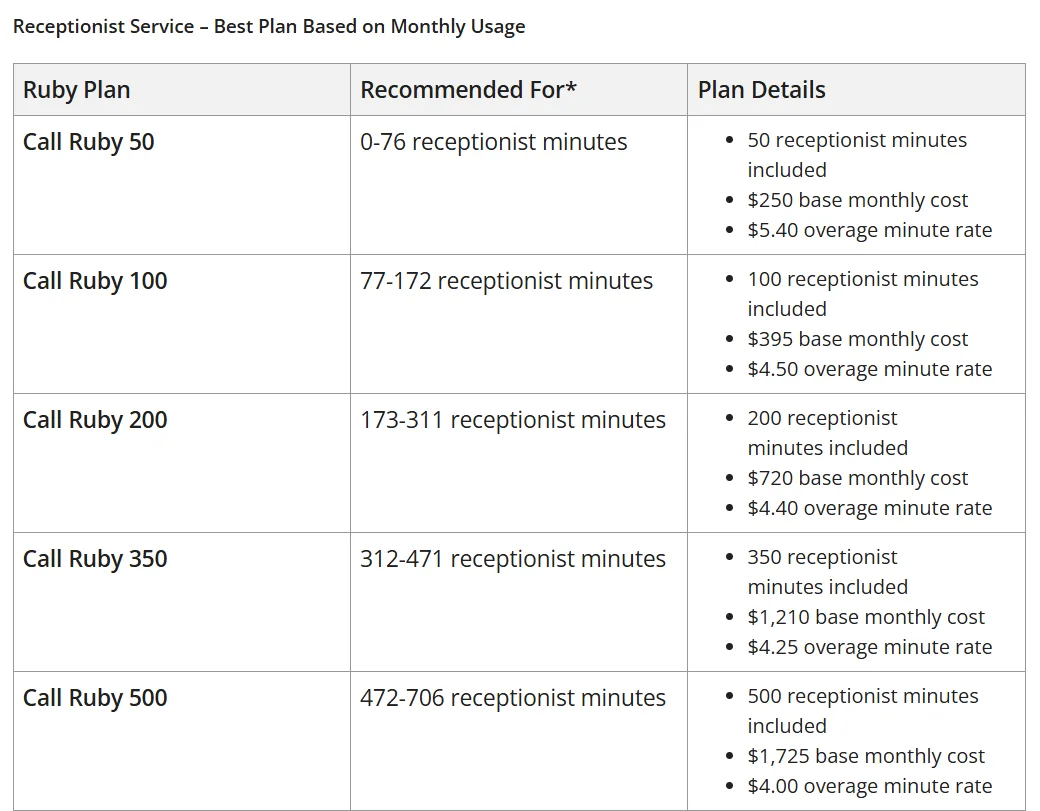
Ruby’s support center lists a usage interval for every plan. We compared those intervals with the pricing for each monthly total from 1 to 3,000 minutes, and the result matches: within every interval, the plan Ruby suggests is the least expensive, with overage minutes billed at that plan’s own rate.
| Plan | Cheapest for | At the top |
|---|---|---|
| Call Ruby 50 | 0 to 76 minutes | $390.40 next: $395 |
| Call Ruby 100 | 77 to 172 minutes | $719 next: $720 |
| Call Ruby 200 | 173 to 311 minutes | $1,208.40 next: $1,210 |
| Call Ruby 350 | 312 to 471 minutes | $1,724.25 next: $1,725 |
| Call Ruby 500 | 472 to 706 minutes | $2,549 next: $2,550 |
| Call Ruby 750 | 707 to 957 minutes | $3,346.95 next: $3,350 |
| Call Ruby 1,000 | 958 to 1,436 minutes | $4,941.40 next: $4,945 |
| Call Ruby 1,500 | 1,437 to 1,915 minutes | $6,397.50 next: $6,400 |
| Call Ruby 2,000 | 1,916 to 2,433 minutes | $7,872.20 next: $7,875 |
At the top: the plan’s cost, including additional minutes, at the upper end of its range; next: the price of the next higher plan. Taken from Ruby’s help center, accessed on 23 November 2026. The figures at the upper end of each range are our calculations based on Ruby’s prices.
At the upper end of every tier, the smaller plan with extra minutes is priced $0.75 to $4.60 below the following plan, which provides a larger minute allowance. When your usage is close to the upper edge of a tier, the larger plan is roughly the same price and gives you flexibility for a heavier month.
Ruby does not automatically shift you to a higher plan. Instead, it sends email alerts when you reach 85% and 100% of your minutes, while the Ruby app and web portal display your usage in real time. During the first three billing cycles, Ruby may adjust your plan upward or downward for the current period. After that, an upgrade takes effect starting with the current billing period and continues for at least the next two, whereas a downgrade can happen only after three straight billing periods on the same plan and then begins the following period. Minutes you do not use do not carry over.
Live chat plans and bundles
Ruby also provides website chat support, and charges are based on each engaged chat. Purchased separately, the chat packages are priced at $143 for 10 chats, $335 for 30, $520 for 50, and $945 for 100. When bundled with a receptionist plan, the price drops by 20%: $114.40 for 10 chats, $268 for 30, $416 for 50, and $756 for 100. On the pricing page, the 10-chat package is rounded to $115. Chats initiated by a bot, chats containing nonsensical text, and chats that the visitor ends after the initial hello are not charged.
| Chats | Price | Bundled | Extra chat |
|---|---|---|---|
| 10 | $143 | $114.40 | $12.25 / $9.80 |
| 30 | $335 | $268 | $11.10 / $8.88 |
| 50 | $520 | $416 | $10.60 / $8.48 |
| 100 | $945 | $756 | $9.45 / $7.56 |
Bundled: with a Ruby receptionist plan, 20% off. Extra chat: the plan rate first, then the bundled rate. Read on 23 November 2026 from Ruby’s pricing page and help center article about selecting a billing plan, updated 11 December 2025.
What every plan includes
Ruby’s pricing page shows that every plan includes the same set of features: 24/7 live answering, covering nights, weekends, and holidays; Spanish and bilingual answering; scheduling, lead qualification, and intake; payment collection; outbound call assistance; local or toll-free number hosting; and an app that lets you call and text using your business number. The company’s AI features, which help the receptionist find answers during calls, transcribe calls and voicemails, evaluate caller sentiment, and block robocalls, come at no additional charge. Every call is handled by a person; Ruby states that it is not an automated receptionist.
Ruby’s bilingual team handles incoming Spanish-language calls around the clock, 24/7. Meanwhile, outbound call support in English or Spanish is available Monday through Friday from 5 a.m. to 6 p.m. Pacific time. Ruby provides answering services for businesses in the United States, Canada, and the US Caribbean.
Multiple businesses may use a single plan: Ruby can include a separate line bearing its own business name and instructions, which uses the same pool of minutes.
Fees, contract and refunds
- Setup: Ruby’s pricing page states that there are no charges for activation, onboarding, setup or customization, and none for coverage during particular periods.
- Payment: Ruby accepts credit cards, debit cards, ACH and checks. Under its terms, credit card payments incur a 3% surcharge, which amounts to $21.60 per month on the $720 plan, while debit cards, ACH and checks are not subject to any surcharge.
- Billing dates: the plan fee is charged upfront at the start of each period, and additional minutes are billed once the period has ended, on the next invoice. Applicable sales and use taxes are determined by your address.
- Contract: each agreement remains in force for 30 days and then renews automatically. You may cancel at any point before your next invoice date by contacting Ruby by email or phone; the cancellation becomes effective when the current billing period ends.
- Refund policy: new customers are eligible to end service and receive all their money back within 21 days after enrollment, or prior to using 500 receptionist minutes, whichever happens first; the cancellation is effective immediately. The terms also note that this guarantee can differ, and its duration is disclosed at sign-up.
- Late payment: if a payment arrives more than 30 days after its due date, Ruby may impose a $10 late fee plus monthly interest of 1.5%.
- Discounts: Ruby provides special pricing, including continuing reductions available via certain professional associations. Only one promotional deal and one association perk may be used at once, and they cannot be combined.
- Your number: if your account is in good standing, you may take your number with you when you leave, provided Ruby hosted your own number or assigned its number more than 21 days earlier. Transferring calls to numbers outside North America may cost extra.
Ways to use fewer minutes
Ruby’s support center recommends the following methods for reducing minute usage:
- Let Ruby pick up only after the phone rings twice, so your team handles the calls it can and Ruby covers the remainder.
- Enable or disable call forwarding on your line whenever you want; the Ruby application and portal display your minutes, allowing you to stop close to your plan’s limit.
- Route incoming callers to voicemail rather than having a receptionist record a detailed message.
- Reduce the live-answer window for Ruby: any calls routed to your after-hours voicemail will not incur charges.
- If you still have some minutes remaining, spend them on outbound call support, such as confirming appointments.
How Ruby’s price compares
In our guide to answering service pricing, handling 100 two-minute calls per month ranges from $269 to $915 among 10 live answering services, and the median price is $405.75; Ruby’s Call Ruby 200 plan includes that volume for $720. For the same call load, AI answering services are priced from $49 to $212.50, using software to answer rather than a human.
Employing a full-time receptionist typically costs roughly $47,343 per year after payroll taxes and benefits are included. By comparison, Ruby’s Call Ruby 200 plan costs $8,640 annually for 100 calls each month and provides 24/7 answering.
Which plan fits
Tally the calls from last month in your phone system’s call history, then multiply that number by 2 minutes, which is Ruby’s usual receptionist time per call; if your calls involve lengthy intake forms, use a larger estimate. After that, choose the plan whose minute range contains the total: Call Ruby 50 covers 0 to 76 minutes, Call Ruby 100 covers 77 to 172, Call Ruby 200 covers 173 to 311, Call Ruby 350 covers 312 to 471, and Call Ruby 500 covers 472 to 706.
If you’re uncertain, begin with the lower-tier plan. During the first three billing cycles, Ruby can move you to a higher plan for the current period, and if a bill shows that a different plan is a better fit, Ruby says it will upgrade you starting from the beginning of the current billing period.
Questions buyers ask
How much does Ruby cost?
Ruby’s pricing is $250 per month for 50 receptionist minutes, $395 for 100 minutes, $720 for 200 minutes, and $1,725 for 500 minutes. The larger plans go up to $7,875 for 2,500 minutes. Additional minutes are billed at $3.30 to $5.40 each, depending on the plan. Prices checked 23 November 2026.
Does Ruby charge per minute or per call?
Receptionist time is billed by the minute. Every call is rounded upward to the nearest whole minute. Time spent on hold is included, and so is the time a receptionist uses to complete your message after the caller disconnects.
How much is an extra minute on Ruby?
Your plan determines the rate: it is $5.40 on Call Ruby 50, $4.50 on Call Ruby 100, $4.40 on Call Ruby 200, $4.25 on Call Ruby 350, and $4.00 on Call Ruby 500, falling to $3.30 on Call Ruby 2,500.
Do unused Ruby minutes roll over?
No, any unused minutes lapse when each billing cycle concludes. If you still have minutes left over, Ruby recommends putting them toward outbound call assists.
Does Ruby require a contract?
No long-term commitment applies. Every agreement lasts 30 days and is renewed automatically. You may terminate it before the next billing date, and the cancellation becomes effective when the current term ends.
Does Ruby have a money-back guarantee?
Yes. New customers can receive a complete refund if they cancel within 21 days after enrolling, or before they use 500 receptionist minutes, whichever happens first.
Does Ruby charge a setup fee?
No. Ruby’s pricing page states that no fees apply for activation, onboarding, setup, customization, or coverage during certain periods. In addition, its terms impose a 3% surcharge on credit card payments.
Does Ruby answer calls in Spanish?
Yes, with no additional charge. Ruby’s bilingual staff handles inbound Spanish-language calls around the clock, 24/7, and Spanish outbound call assistance is available Monday through Friday from 5 a.m. to 6 p.m. Pacific time.
Is Ruby an AI receptionist?
No. Every call is answered by a person. Ruby’s AI tools operate behind the scenes, locating answers for the receptionist, converting calls and voicemails into text, and screening out robocalls, and they come with every plan at no additional charge.
Does Ruby charge more for after-hours calls?
There is no additional fee for calls made at night, on weekends, or on holidays; they simply count against your minutes like any other call. If a call is routed to your after-hours voicemail, it is not charged.
Sources and method
- Ruby plans and pricing (vendor-published), read and captured 23 November 2026
- Am I on the right billing plan?, Ruby help center, updated 11 December 2025, read and captured 23 November 2026
- Ruby Billing Basics, Ruby help center, updated 9 September 2026, read 23 November 2026
- How long is an average call?, Ruby help center, 10 April 2026, read 23 November 2026
- Tips for Keeping Costs Low, Ruby help center, 31 July 2026, read 23 November 2026
- Can I combine discounts?, Ruby help center, 5 May 2025, read 23 November 2026
- Bilingual Service Options, Ruby help center, 4 February 2025, read 23 November 2026
- Ruby FAQs (vendor-published), read 23 November 2026
- Ruby Terms of Use, last updated March 2026, read 23 November 2026
- Ruby AI features (vendor-published), read 23 November 2026
- Other services' prices at 100 calls: our answering service cost guide, from each service's pricing page, checked 23 November 2026; receptionist cost: our receptionist cost guide (BLS data)