AI phone answering is a service that picks up your business line when you can't, talks to the caller in a natural voice, and does the receptionist's work: answers questions, books appointments, takes messages and passes urgent calls to a person. Vendors sell the same thing under three names, AI phone answering service (or system), AI phone receptionist and AI virtual receptionist. This guide explains how it connects to the number you already have, what happens on a call, the three ways vendors charge and what 100 calls a month costs under each, how to set it up in an afternoon, and where it still falls short of a person. Prices are from the vendors' own pricing pages, checked 30 September 2026 unless noted. Our home page ranks fourteen of these services; this page is for understanding the thing before you pick one.
Some vendors on this page pay us a commission if you sign up through our links. It doesn't change which tools we list or what we say about them. How we compare.
What AI phone answering is, and the three names for it
Under all three names it is the same product: software in the vendor's cloud, attached to a phone number, that answers calls with an AI voice agent built for one job. There is no hardware and no app to install on your phones. You keep your phone system, your mobiles and your number; the only change is where unanswered calls go.
- AI phone answering service or system is the general term, and the one established answering-service companies use for their AI tier. Smith.ai, for example, sells an AI receptionist in front of its live receptionists.
- AI phone receptionist stresses what it does on the call: greets, books, takes messages and transfers, like a front-desk person. Most of the services on our home page use this name.
- AI virtual receptionist borrows the name of the human service it replaces. A virtual receptionist on its own usually means a person working remotely from a call center; we compare ten of those in our virtual receptionist guide. Add “AI” and it means the software.
What it is not: a phone menu (“press 1 for sales”), a voicemail transcription, or a chatbot on your website. An AI phone answering service holds a conversation, can be interrupted, and acts during the call. The engine underneath, speech recognition plus a language model plus a synthetic voice, is the same one our AI voice agents guide takes apart; this page stays on the inbound-call product.
How it connects to the number you already have
Every service gives you a phone number in its system. The question is how calls to your existing number reach it. There are four ways, and the one you pick decides whether the AI answers every call or only the ones you miss.
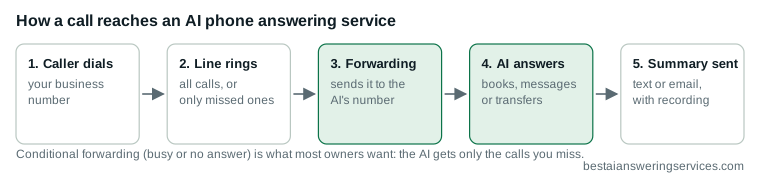
| Way to connect | What happens | Who it suits | Examples |
|---|---|---|---|
| Forward only missed calls | Your phones ring first. After a set number of rings, or when the line is busy, the carrier sends the call to the AI. Also called conditional forwarding | Owners who answer most calls themselves and want after-hours and overflow cover | KaiCalls is built around this (it calls itself a backup receptionist); every other service supports it through your carrier |
| Forward every call | All calls go straight to the AI, which transfers the ones that need you | Businesses that want every call screened and booked, or that get more calls than they can answer | Any service; the usual setup for Upfirst, Dialzara, Rosie and My AI Front Desk |
| Give out the AI's number | A new local or toll-free number for ads, your website or a second line | New businesses, or a separate line for one campaign | Included with most plans; Dialzara charges $3 a month for a local number and $5 for toll-free |
| Port your number in | The number moves to the AI vendor, which becomes your carrier | Businesses replacing an old phone system | Dialzara and KaiCalls port numbers free; Quo requires it; AptaBook and My AI Front Desk do not port, they forward |
Vendor details from each pricing page and help center, checked 30 September 2026; AptaBook and KaiCalls from the vendors by email, 12 and 13 October 2026.
Forwarding is set with a short code dialed from the phone, or in the carrier's app. On AT&T and T-Mobile, **21* plus the AI's number then # forwards every call and **61*…# forwards only unanswered calls; on Verizon it is *72 and *92 followed by the number. The cancel codes are ##21#, ##61# and *73 (800.com's carrier code list). Carriers change these, so check your own carrier's page, and test with a call from a mobile before you rely on it. On a desk phone system (RingCentral, Nextiva, Ooma Office) the same rules live in the admin portal under call handling.
What happens on a call
A good AI phone answering service runs the same sequence a trained receptionist would, in about the same time.
- It answers in a ring or two, with your greeting and your business name, and says it is an AI if you tell it to. We recommend you do; see where it falls short.
- It works out who is calling and why. Several services remember repeat callers by number (Upfirst and Answrr say so on their sites) and greet them by name.
- It answers from your information: hours, prices, service area, parking, what you do and don't do. You type this in during setup, or paste your website, and it should say “I'll have someone call you back” for anything you didn't give it.
- It books, if that is the job. The better services look at your calendar's open slots during the call and book into them: Upfirst into Google, Outlook, Calendly, Acuity, Square and Clio; Dialzara, My AI Front Desk, RingCentral and AptaBook into theirs. Cheaper plans text the caller a booking link instead; Rosie's $49 plan, Cira, Goodcall and Quo work that way.
- It transfers the calls that need you, to your mobile or a colleague, with a one-line summary for whoever picks up. Some services try several numbers in turn (Rosie's $299 plan) or hand off to a live receptionist (Smith.ai).
- It takes a message for everything else and texts the caller anything you asked it to: directions, a form, a quote request.
- It reports back. Within a minute you get a text or email with the caller's name and number, what they wanted, the recording and the transcript. Most services log the call to your CRM or job software too: Rosie to Jobber, Housecall Pro and ServiceM8; Upfirst to Clio; RingCentral to Salesforce, HubSpot and Zoho.
Spam is the one call type you want it to refuse. Upfirst doesn't count blocked spam, robocalls or calls under 15 seconds against your plan; Dialzara and Rosie don't count blocked spam; Smith.ai waives calls from over 20 million known spam numbers. Services that bill per minute without a spam rule make you pay for the robocall.
The three ways vendors charge
This is where AI phone answering differs from the human service it replaces. Live receptionists charge per minute, nearly always. AI services split three ways, and the split decides which one is cheapest for you.
| Model | You pay for | Cheapest when | Who uses it |
|---|---|---|---|
| Per call | Each answered call, however long it runs | Your calls are long: quotes, intake, questions | Upfirst ($24.95 for 30 calls), Smith.ai ($150 for 75), Quo with Sona ($25 for 40, on a Quo line) |
| Per minute | Talk time, usually in a monthly allowance with overage | Your calls are short: bookings, hours, directions | Dialzara ($29 for 60 minutes), Rosie ($49 for 250), My AI Front Desk ($99 for 200), RingCentral ($49 for 100), Answrr ($99 for 300), Ooma ($14.99 add-on for 40) |
| Per conversation or caller | Each conversation, or each unique caller, whatever its length | Long calls, repeat callers, or a mix of phone and chat | Cira ($59 for 200 conversations), AptaBook ($49 for 50, a call of up to 30 minutes counts as one), Goodcall ($79 for 100 unique callers, unlimited minutes) |
Entry plans from each vendor's pricing page, checked 30 September 2026; AptaBook checked 12 October 2026.
Two services sit outside the table. KaiCalls charges a flat $10 a month for about 20 answered calls and says it keeps answering above the allowance while recommending the next plan (per KaiCalls, 13 October 2026). Allo sells its AI receptionist as a $32-a-month add-on to its phone system and publishes no usage limit at all.
What 100 calls a month cost, short and long
Take a business that gets 100 calls a month. If the calls average one minute (booking, “are you open”, directions), the per-minute services win. If they average three minutes (a quote, an intake, a worried patient), the order flips. Same vendors, same month, different bill.
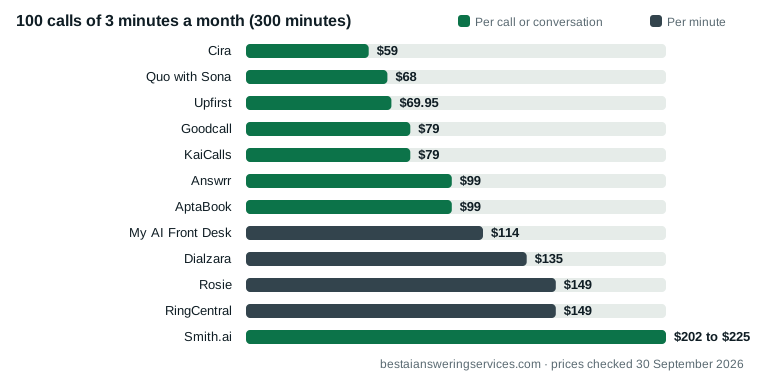
| Service | Model | 100 calls of 1 minute | 100 calls of 3 minutes | How we got there |
|---|---|---|---|---|
| Upfirst | Per call | $69.95 | $69.95 | Premium plan, 90 calls, plus 10 extra at $1.00 |
| Dialzara | Per minute | $48.20 | $135 | $29 plan plus 40 minutes at $0.48; then the $99 plan plus 80 minutes at $0.45 |
| Rosie | Per minute | $49 | $149 | The $49 plan covers 250 minutes but texts a booking link and has no transfers; 300 minutes needs the $149 plan because the overage rate isn't published |
| My AI Front Desk | Per minute | $99 | $114 | 200 minutes plus 40 minutes of included credits, then 60 minutes at $0.25 |
| RingCentral AI Receptionist | Per minute | $49 | $149 | 100 minutes included, then 200 minutes at $0.50 |
| Answrr | Per minute | $99 | $99 | 300 minutes on the entry plan |
| Cira | Per conversation | $59 | $59 | 200 conversations on the entry plan |
| AptaBook | Per conversation | $99 | $99 | The $49 plan stops at 50 conversations with no overage, so 100 calls need the $99 plan (400) |
| Goodcall | Per unique caller | $79 | $79 | 100 callers, unlimited minutes, if every call is a different caller |
| Quo with Sona | Per call | $68 | $68 | $19 Quo phone plan plus the $49 tier for 100 calls |
| KaiCalls | Flat | $79 | $79 | Kai Line, about 170 answered calls, if it answers every call |
| Smith.ai AI Receptionist | Per call | $202 to $225 | $202 to $225 | $150 for 75 calls plus 25 extra at the published $2.10 to $3.00 overage |
Published plans and overage from each vendor's pricing page, checked 30 September 2026; AptaBook and KaiCalls checked 12 October 2026. Taxes and phone-number fees excluded. Ooma's $14.99 add-on covers 40 minutes and its bigger plans are priced by sales, so it isn't shown.
The pattern: below about two minutes a call, Dialzara, Rosie and RingCentral are the cheapest plans that still book; above it, the per-call and per-conversation services are, and their bill doesn't move when a caller talks for ten minutes. Time your last twenty calls before you choose. Our home page has a calculator for your own volume.
Setting it up in an afternoon
- Write down what callers ask. Hours, prices, service area, how to book, what you don't do, and what counts as urgent. This becomes the AI's knowledge; the services read your website too, but the list is what makes the answers yours.
- Pick a trial that matches your calls. Upfirst and AptaBook give 14 and 15 days without a card; Dialzara, Rosie, My AI Front Desk and Cira give 7 days; RingCentral and Goodcall 14. KaiCalls charges $2 for the first week.
- Connect the calendar and, if you have one, the CRM or job software. This is the step to check before you pay: Dialzara's own pages disagree about which plan includes Outlook and Apple Calendar, and a Capterra reviewer says a My AI Front Desk integration they were promised didn't exist.
- Set the transfer rules. Who gets urgent calls, in what order, and what happens when nobody picks up. Decide whether the AI says it is an AI.
- Forward missed calls first, using the carrier codes above, and live with it for a week before forwarding everything.
- Call it yourself, ten times. From a mobile outdoors, with a question it was given and one it wasn't, with an interruption, with a request for a person, and in Spanish if your customers speak it. Then read the transcripts. Our test plan has the full list.
Upfirst reviewers report going live in under 20 minutes (Capterra); Answrr sets the agent up for you within 24 hours. Budget the afternoon anyway, for the knowledge list and the test calls.
Where AI phone answering still falls short
- Pauses, noise and interruptions. The recurring complaints in the reviews of Upfirst, the best-rated service we cover, are pauses, talking over callers who pause, and trouble with background noise (G2, Capterra). Smith.ai reviewers mention misheard names and email addresses (Trustpilot). A caller in a truck on speakerphone is the hardest case; test that one.
- Some callers hang up on an AI. In a Gartner survey of 5,728 customers (December 2023), 64% said they would prefer companies didn't use AI for customer service, and the top worry was not being able to reach a person (Gartner). The services that keep those callers say what they are, keep it short and transfer on request. The FCC has proposed making an AI disclosure at the start of calls that use AI-generated technology mandatory (Federal Register).
- Judgment calls. A patient describing symptoms, a client asking whether they have a case, a tenant with a gas smell: the AI should transfer, not advise, and you have to tell it which situations those are. Our guides for dentists, law firms, HVAC companies and plumbers have the scripts.
- Compliance is uneven. For patient information you need a signed business associate agreement. RingCentral and AptaBook provide one, Allo charges $50 a month for it, Upfirst only on a custom plan over 600 calls, and Smith.ai says it is not HIPAA compliant. Call recording needs the caller's consent in some US states; have the AI say the call may be recorded.
- Billing surprises. The complaints about refunds after cancelling cluster at a few vendors (My AI Front Desk, Smith.ai, Goodcall and Allo in the reviews we read; details on our home page). Read the cancellation terms before an annual prepayment.
AI phone receptionist, human virtual receptionist, or voicemail
| AI phone answering | Live virtual receptionist | Voicemail | |
|---|---|---|---|
| Answers | Every call, 24 hours, at once | During the hours you pay for; callers can queue | Nobody; the caller leaves a message or hangs up |
| Books appointments | Yes on most plans, from your calendar's open slots | Yes, with your calendar access | No |
| Handles the unexpected | Transfers or takes a message; can't improvise | Yes, within the script you give them | No |
| Cost at 100 three-minute calls | $59 to $225 (table above) | About $300 to $600 for 300 minutes on the plans in our virtual receptionist guide | Free, plus the jobs you lose |
| Setup | An afternoon | Days: onboarding call, scripts, training | Minutes |
| Best for | Short, repeatable calls at any hour; businesses that want the bill to stop moving | Callers who need a person: upset customers, complex intake, sales conversations | Nobody who depends on the phone |
The middle path is a service with both: Smith.ai hands off from the AI to a live receptionist in North America when the AI is stuck, free when the AI starts it, from $150 a month for 75 calls. Our virtual receptionist guide prices ten live services at 100, 250 and 500 minutes, and the AI-or-human section of the home page works through the choice.
Which one to try first
- Most small businesses: Upfirst, per call from $24.95, booking and transfers on every plan, 14 days and 100 calls free without a card; we signed up and recorded the setup.
- Short calls on a budget: Dialzara, $29 for 60 minutes with real in-call booking.
- Long calls or lots of them: Rosie at $149 for 1,000 minutes, or Cira at $59 for 200 conversations if a texted booking link is enough.
- Only the calls you miss: KaiCalls, $10 a month for about 20, with your phones ringing first.
- A person behind the AI: Smith.ai, from $150 for 75 calls.
- Patient information: RingCentral or AptaBook, both with a BAA; see the dental guide.
The full ranking of all fourteen, with what each entry plan really includes and what customers complain about, is on our home page.
Questions people ask
What is AI phone answering?
A cloud service that answers your business phone with an AI voice agent: it greets the caller, answers questions from the information you gave it, books appointments into your calendar, takes messages and transfers urgent calls to a person. It is sold as an AI phone answering service or system, an AI phone receptionist, or an AI virtual receptionist; the product is the same.
Is an AI phone receptionist the same as a virtual receptionist?
No. A virtual receptionist is usually a person working from a call center who answers your calls during the hours you pay for. An AI phone receptionist, or AI virtual receptionist, is software that answers around the clock and costs less per call. Some services combine the two, with a person taking over when the AI is stuck.
Can I keep my phone number?
Yes. Most owners keep their number and forward calls to the AI's number, either every call or only the ones they miss, using a code dialed on the phone or a setting in the carrier app. A few vendors can also port your number in (Dialzara and KaiCalls for free; Quo requires it), and some only forward (AptaBook, My AI Front Desk).
Can the AI answer only the calls I miss?
Yes. Conditional call forwarding sends a call to the AI only when your line is busy or unanswered after a set number of rings. On AT&T and T-Mobile the code is **61* followed by the AI's number and #; on Verizon it is *92 followed by the number. KaiCalls is designed for exactly this, at $10 a month for about 20 answered calls.
How much does an AI phone answering service cost?
Entry plans run from $10 a month (KaiCalls, about 20 missed calls) and $24.95 (Upfirst, 30 calls) to $99 (My AI Front Desk, Answrr). For 100 three-minute calls a month the published plans come to $59 (Cira) to $225 (Smith.ai), and the order changes with call length: per-minute plans are cheapest for short calls, per-call and per-conversation plans for long ones. Prices checked 30 September 2026.
Can an AI phone answering service book appointments?
Yes, when it is connected to your calendar. Upfirst books into Google, Outlook, Calendly, Acuity, Square and Clio; Dialzara, My AI Front Desk, RingCentral and AptaBook book from your calendar's open slots during the call. Cheaper plans text the caller a booking link instead.
Will callers know they are talking to an AI?
Many will, and callers who are misled tend to hang up. Have the AI say what it is at the start and offer a person; in a Gartner survey, 64% of customers said they would rather companies didn't use AI for customer service, mostly for fear of not reaching a person. The FCC has proposed making an AI disclosure mandatory on calls that use AI-generated technology.
What happens with an emergency call?
The AI follows the rules you set: it recognises the situations you listed as urgent (a burst pipe, a gas smell, a patient in pain, a client's court date) and transfers the call to the number or numbers you chose, with a summary. It should never advise. Test the transfer path, including what happens when nobody picks up.
Does it work with my mobile phone?
Yes. Forwarding is set on the mobile carrier, so a business run from a mobile can send missed calls to the AI and still get transfers back to the same phone. The call summary, recording and transcript arrive by text or email.
Is AI phone answering HIPAA compliant?
Only with a signed business associate agreement. RingCentral and AptaBook provide one, Allo charges $50 a month for it, Upfirst offers it only on a custom plan over 600 calls, and Smith.ai says it is not HIPAA compliant. Our guide for dentists compares every BAA option.
Can it answer in Spanish?
Most services can. Upfirst lists 35+ languages and switches mid-call, Dialzara 10+ detected from the caller's first words, My AI Front Desk and AptaBook 20+, RingCentral 6; Rosie, Smith.ai and Cira list English and Spanish. Test it with a Spanish-speaking caller before you rely on it.
What is the best AI phone answering service?
For most small businesses, Upfirst: per-call billing from $24.95 a month, booking, transfers, texting and recordings on every plan, spam not counted, and a 14-day trial without a card. Dialzara is the pick for short calls on a budget, Rosie for long calls or high volume, KaiCalls for missed calls only, and Smith.ai when you want a person behind the AI.
Sources
- Upfirst, Dialzara, Rosie, My AI Front Desk, Smith.ai, RingCentral, Answrr, Cira, Goodcall, Quo, Allo and Ooma pricing pages and help centers, checked 30 September 2026; AptaBook and KaiCalls pricing pages, checked 12 October 2026, and the vendors by email, 12, 13 and 15 October 2026
- 800.com, “Call forwarding codes by mobile carrier” (support article), read 16 October 2026
- G2 and Capterra reviews for Upfirst; Trustpilot reviews for Smith.ai, My AI Front Desk, Goodcall and Allo, read 30 September 2026
- Gartner press release, 9 July 2024; FCC proposed rule on AI-generated calls, Federal Register, 10 September 2024