Loop Voice review: inside the AI agent that calls abandoned carts
Loop Voice let us into a live store's workspace. Here is how a cart-recovery flow is built, what the agent is allowed to say, when it may call, and what the credits really cost, with 17 screenshots and the store's details blurred.
How we got these screenshots. Loop Voice gave us a login to a live customer workspace on 15 October 2026 so we could see the product, not a demo account. We changed nothing, placed no calls and ran no flows. The store's name, its people, phone numbers and web address are blurred in every image, and we don't publish the store's results. Loop Voice has not paid for this page; links to it may earn us a commission (disclosure).
What Loop Voice is
Loop Voice is an AI voice agent for online stores. It plugs into Shopify (and a few other platforms), waits for an event such as an abandoned checkout, then phones the shopper, answers questions about the order and texts a link to finish. The same agent can answer the store's inbound number. It bills in credits: about 1.5 credits per answered conversation, nothing when nobody picks up (Loop Voice pricing).
- Job
- Calls shoppers after abandoned checkouts, orders and other store events; answers inbound calls
- Price
- $119 / month for 120 credits, up to $3,790 for 6,000; $0.65 per extra credit (seen in the app)
- Platforms
- Shopify, WooCommerce, Checkout Champ, HubSpot, Calendly, Zapier and more: 11 integrations in the app
- Voices
- 91 brand voices from ElevenLabs, xAI and Vapi, in 7 languages
- Quiet hours
- Never before 8:00 AM or after 9:00 PM in the shopper's time zone, whatever you set
- Testing
- A simulator that dials no one and uses no credits, plus a test console that calls your own phone
This page shows what the product looks like from the inside and what each screen does. For prices and alternatives side by side, see our guide to AI abandoned cart recovery calls.
How a cart-recovery flow runs
A flow is a vertical chain of steps on a canvas. The one below is the store's live abandoned-checkout flow: a trigger, a wait, a call, a check on how the call ended, a text for the shoppers who didn't finish, another wait, and a second round.
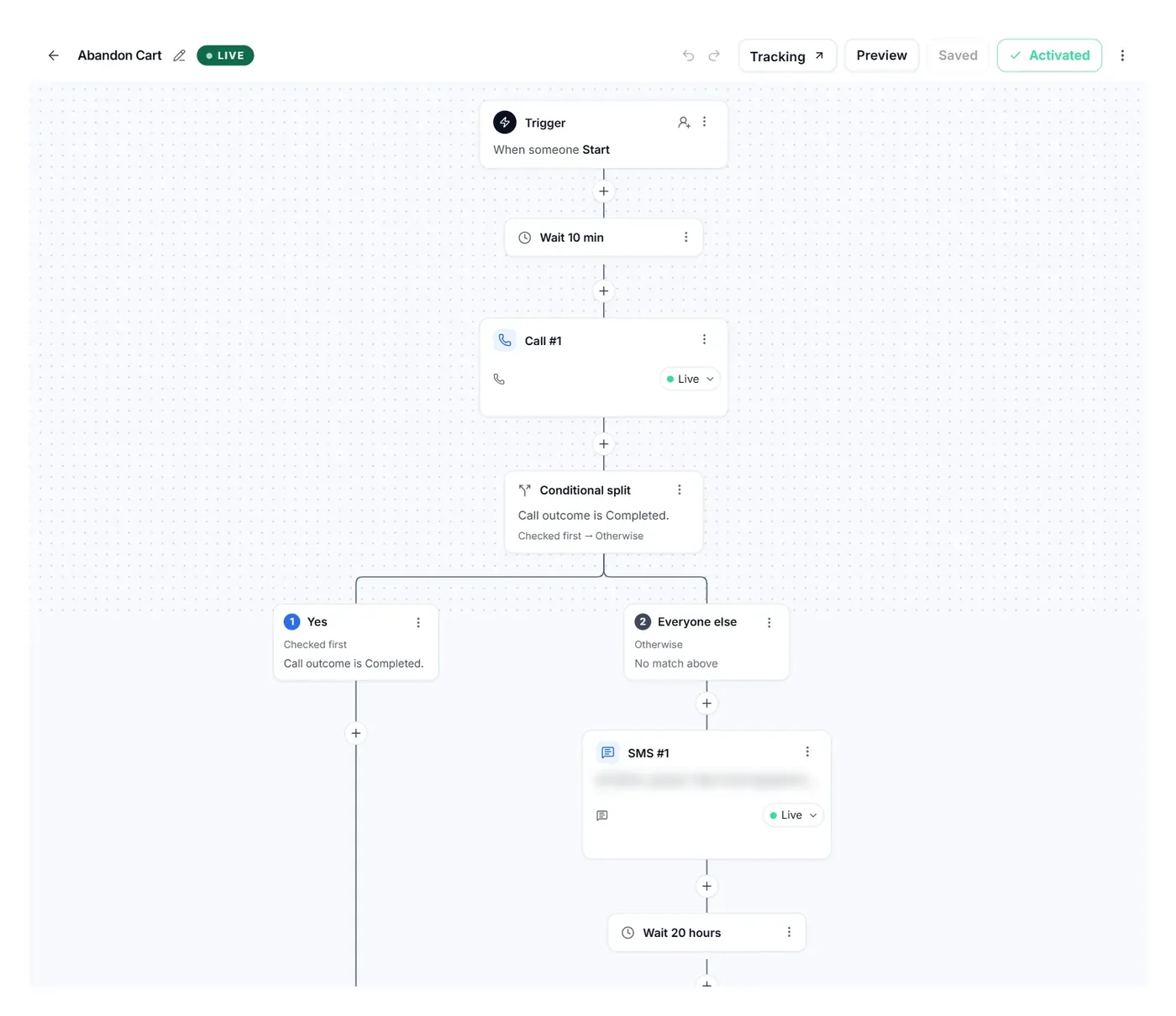
Step by step, as configured in this workspace on 15 October 2026:
- Trigger. Provider Shopify, event “Abandoned checkout”, with an optional delay in minutes. The event menu also lists order placed, order fulfilled, VIP (second order), viewed product, added to cart, a custom event, manual, API and CSV upload; other providers are HubSpot, Calendly and Zapier. Filters can be saved on the trigger, but the editor says the runner doesn't evaluate them yet.
- Wait 10 minutes. Long enough for shoppers who were about to come back anyway.
- Call #1. Picks which agent speaks and which number shows as caller ID. A “DND bypass” switch redials once, about 3 minutes after an unanswered, busy or failed attempt, inside calling hours only; a call that reaches voicemail is not redialed.
- Conditional split. If the call outcome is “Completed”, the shopper leaves the flow. Everyone else gets a text with the checkout link and a reply-STOP line.
- Wait 20 hours, then Call #2, a second split and a second text, then the flow ends.
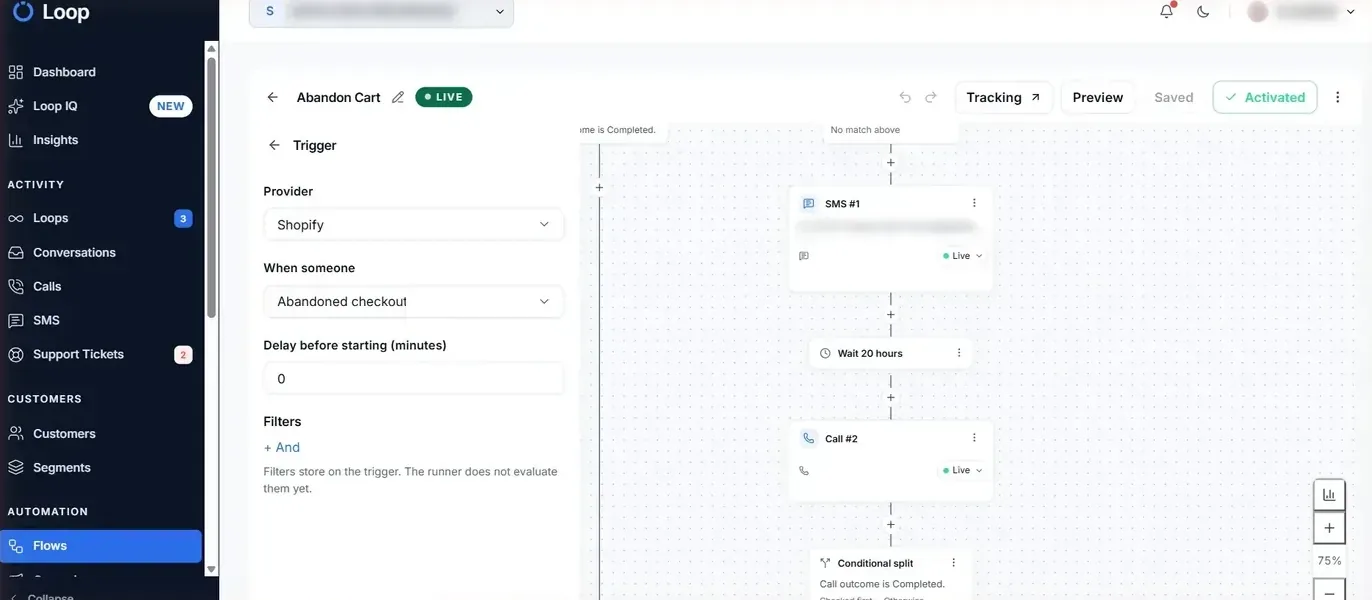
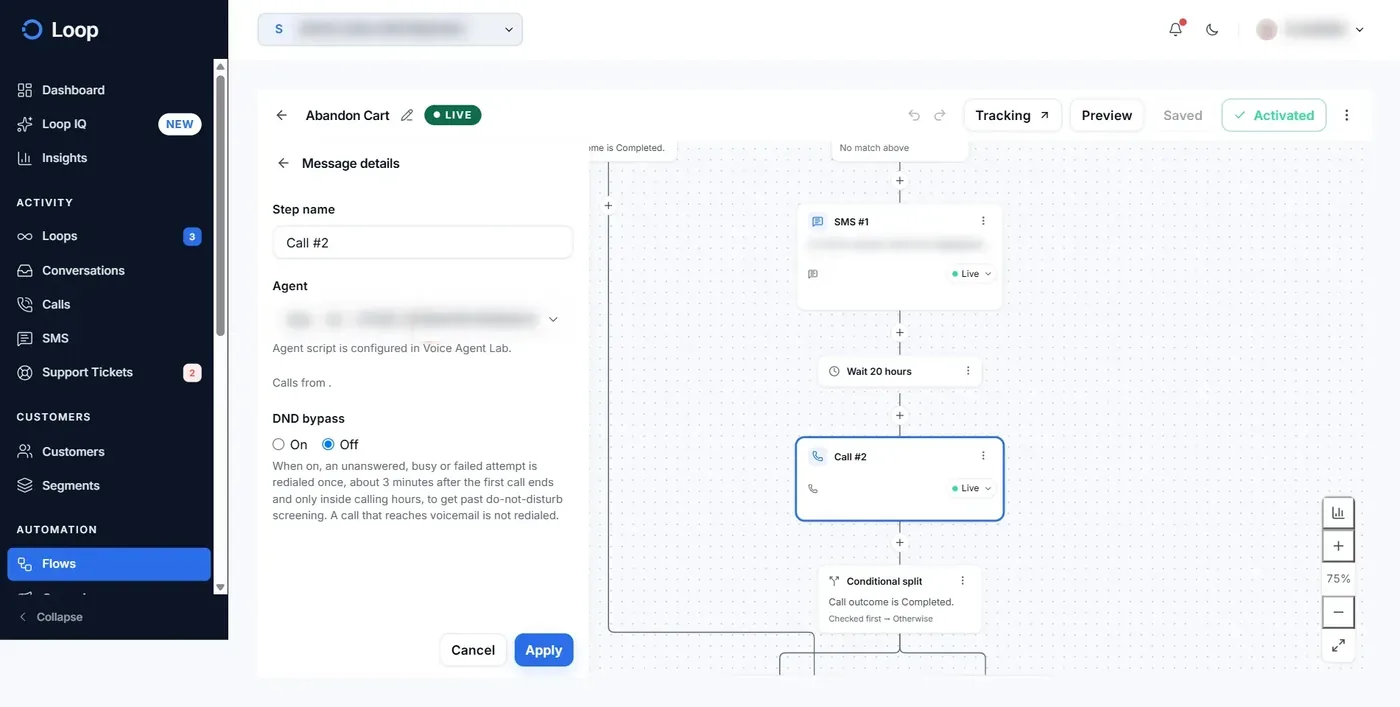
Each step carries its own “Live” badge, and the whole flow is switched on or off from the top bar, so a store can pause calling without deleting anything.
What the agent may say
An agent is the voice, the instructions and the rules. The editor has seven sections: Identity, Instructions, Objectives, Guardrails, Knowledge, Settings and Phone. A test console sits beside it.
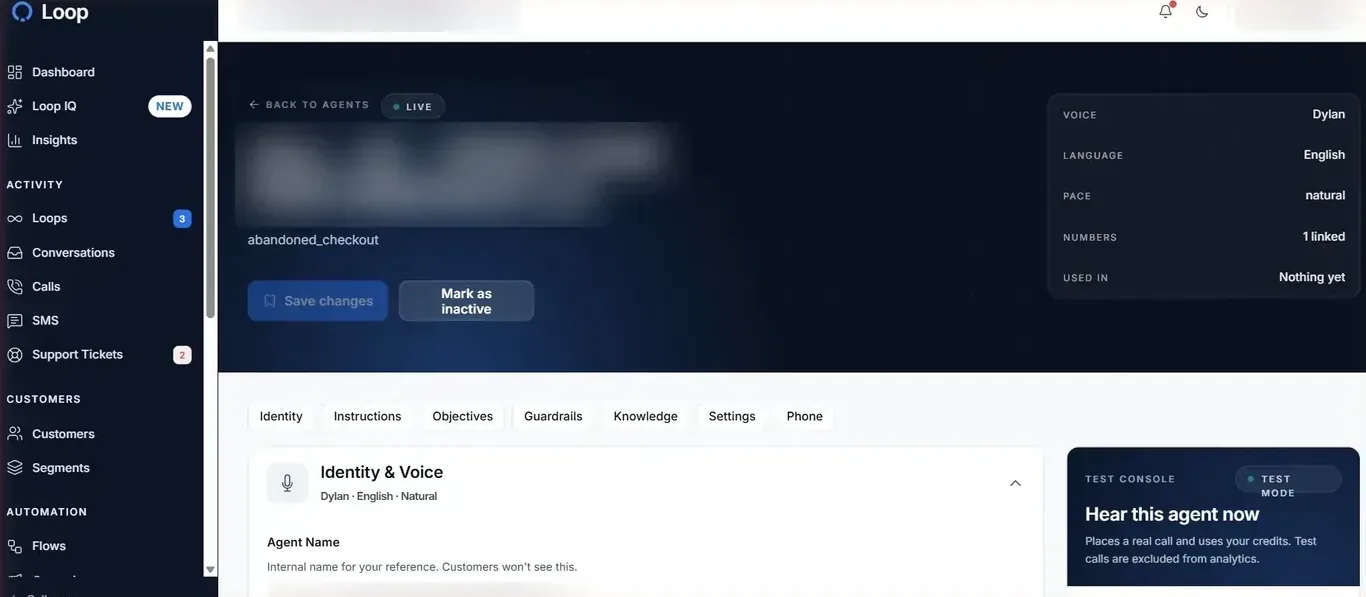
Identity and voice
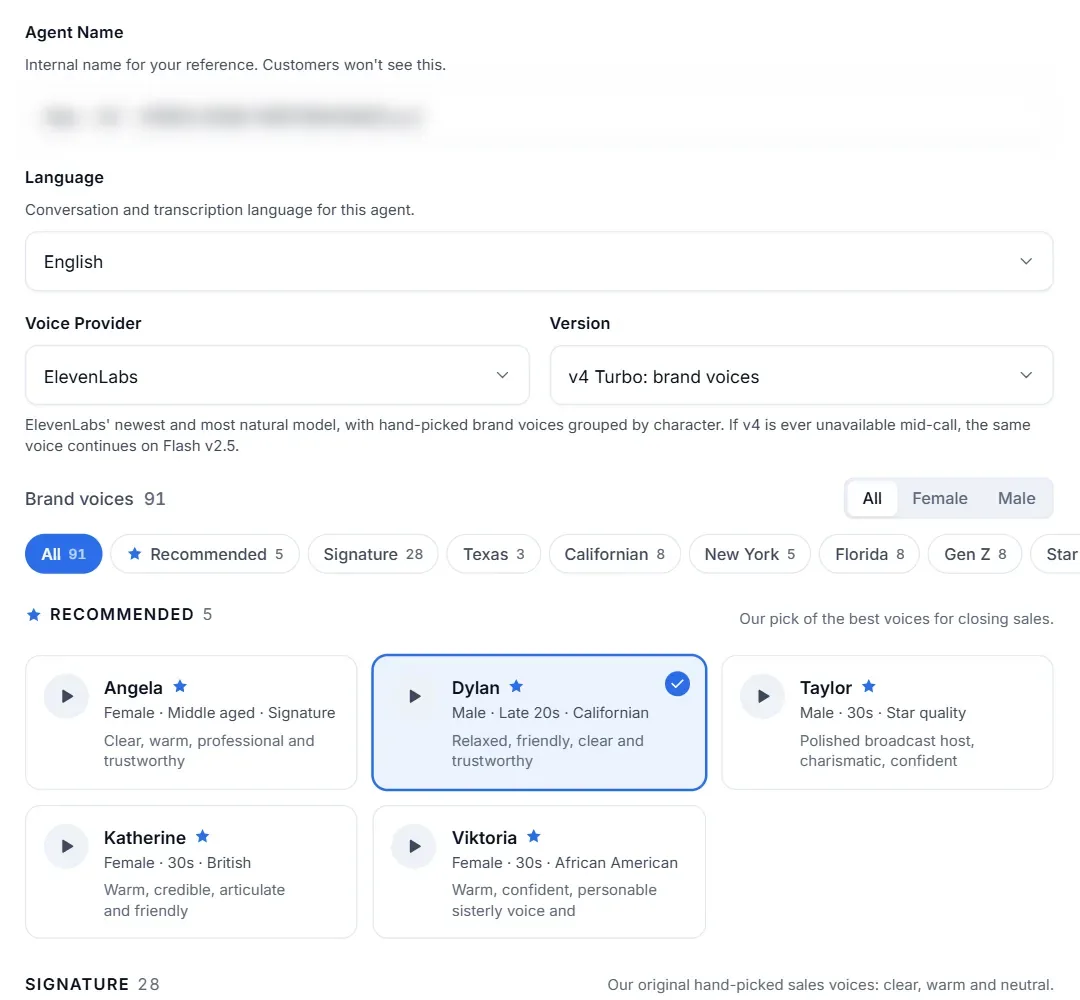
The agent name is internal. The conversation language can be English, German, Dutch, Spanish, French, Italian or Portuguese. Voices come from three providers, ElevenLabs, xAI and Vapi; the ElevenLabs option runs on “v4 Turbo: brand voices” and falls back to Flash v2.5 if v4 drops mid-call. The 91 brand voices are grouped by character (Recommended, Signature, Texas, Californian, New York, Florida, Gen Z, Star quality, Australian, British, African American), each with a short description such as “Male · Late 20s · Californian: relaxed, friendly, clear and trustworthy”. Speaking speed is slow, natural or fast. The opening line is a 500-character template with variables such as the shopper's first name, plus a second line for when the name is unknown.
Guardrails
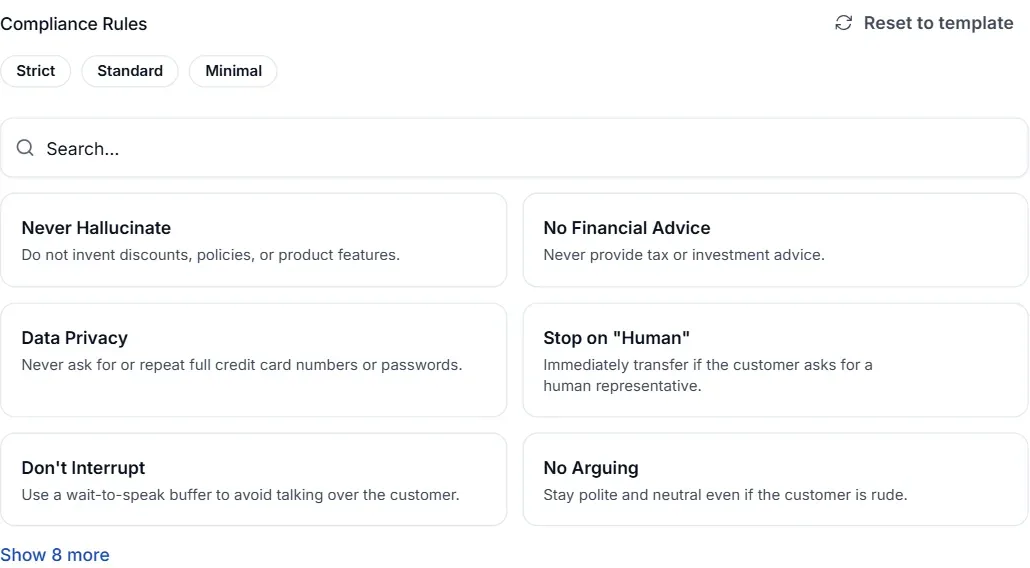
Compliance rules come as three templates, Strict, Standard and Minimal, and as 14 individual switches. The first six are Never Hallucinate (no invented discounts, policies or features), No Financial Advice, Data Privacy (never ask for or repeat full card numbers or passwords), Stop on “Human” (transfer when the shopper asks for a person), Don't Interrupt (a wait-to-speak buffer) and No Arguing. You can add your own rules in plain text.
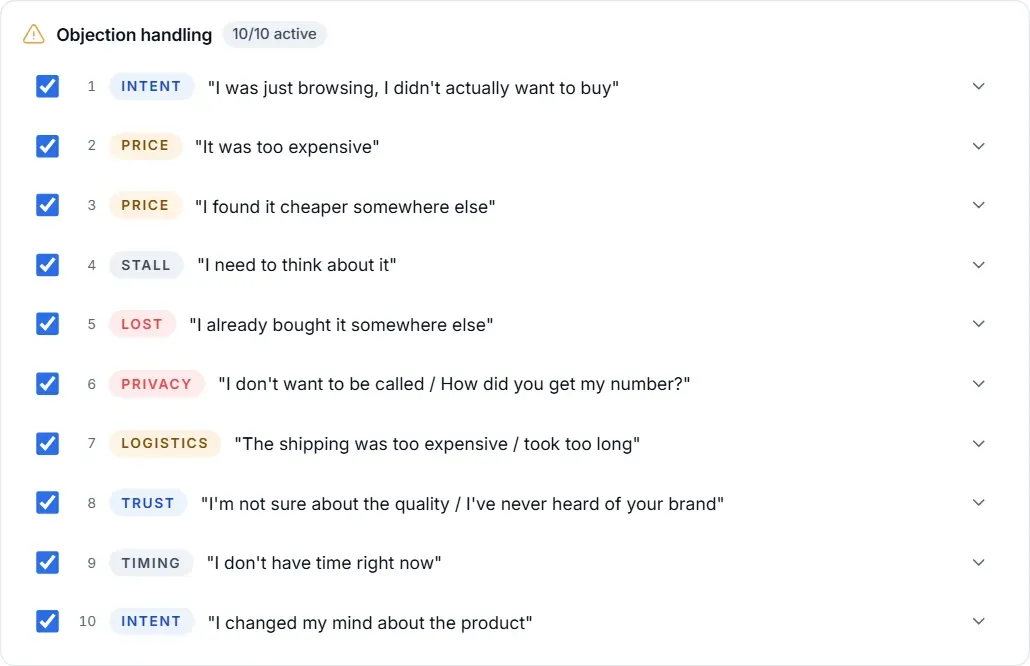
Objection handling is a library of ten objections, each typed as intent, price, stall, lost, privacy, logistics, trust or timing, with an answer the agent follows. All ten were switched on in this workspace.
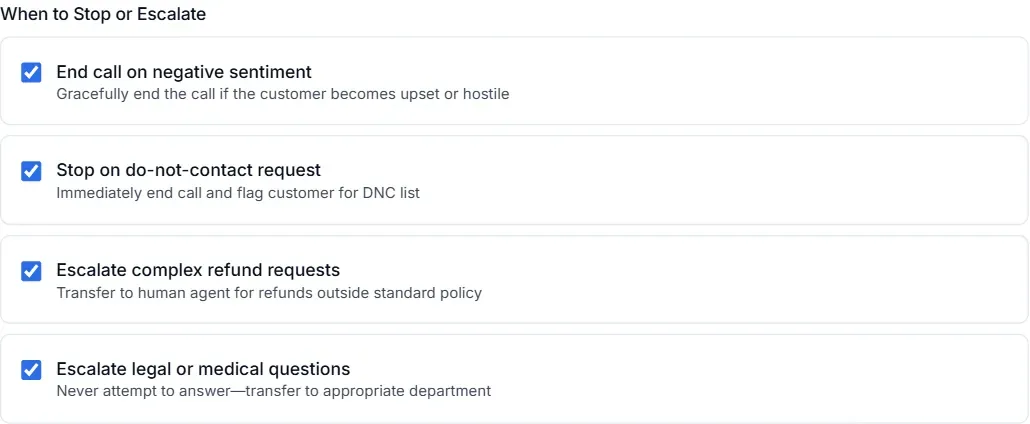
Four stop rules decide when the agent gives up or hands over: end the call on negative sentiment, stop and flag the number on a do-not-contact request, escalate refund requests outside the standard policy, and never answer legal or medical questions.
Limits and escalation
Frequency limits cap how often one agent contacts one customer (a maximum number of calls per week, month, quarter, six months or year). Escalated calls always open a support ticket inside Loop; Zendesk, a Redo inbox or an SMS can be added as a second channel.
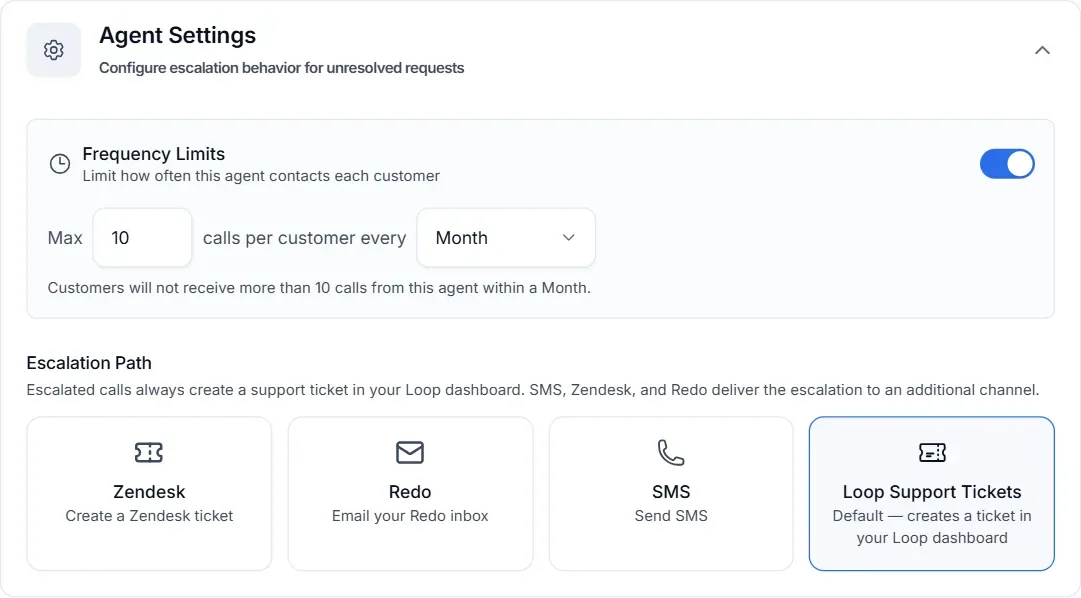
The Instructions section holds the system prompt, with an AI helper that drafts it and a “deep check” that reviews it. We don't show the store's prompt. Discount codes are also set per agent, so the AI can only offer codes you listed.
Numbers, hours and opt-outs
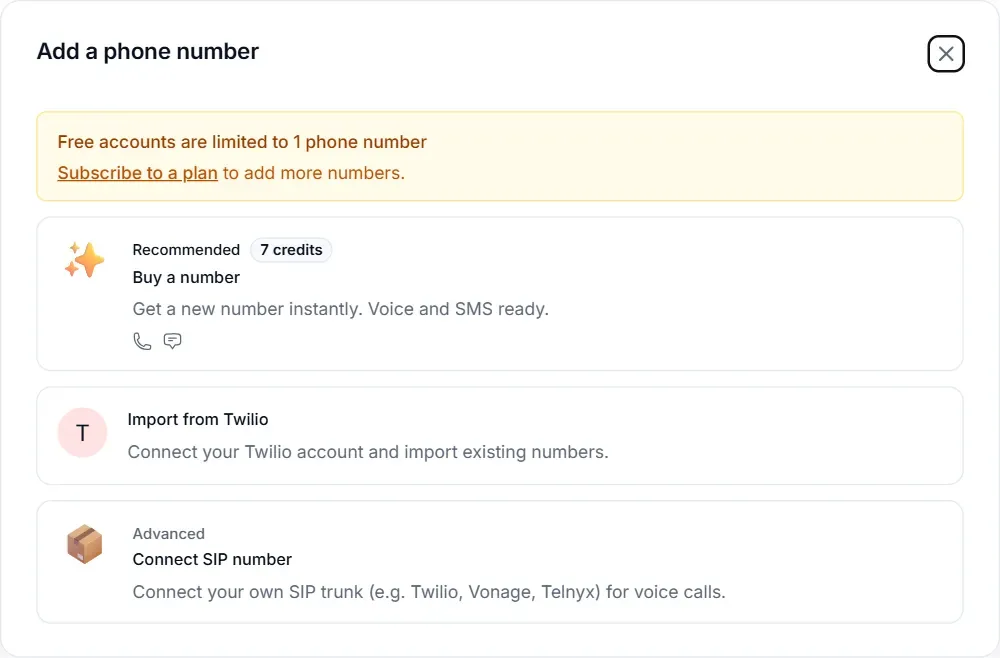
Numbers. You can buy a number from Loop (7 credits, voice and SMS), import numbers from Twilio, or connect a SIP trunk such as Twilio, Vonage or Telnyx. Free accounts get one number; paid plans up to ten. A “Super Number” is a rotating pool that shows a local area code to each shopper; Loop Voice told us this roughly doubles pickup rates (its figure, by email, 15 October 2026). Every number has one designated agent for inbound calls, and a shopper who calls back after an outbound call gets the same agent, so the conversation continues.
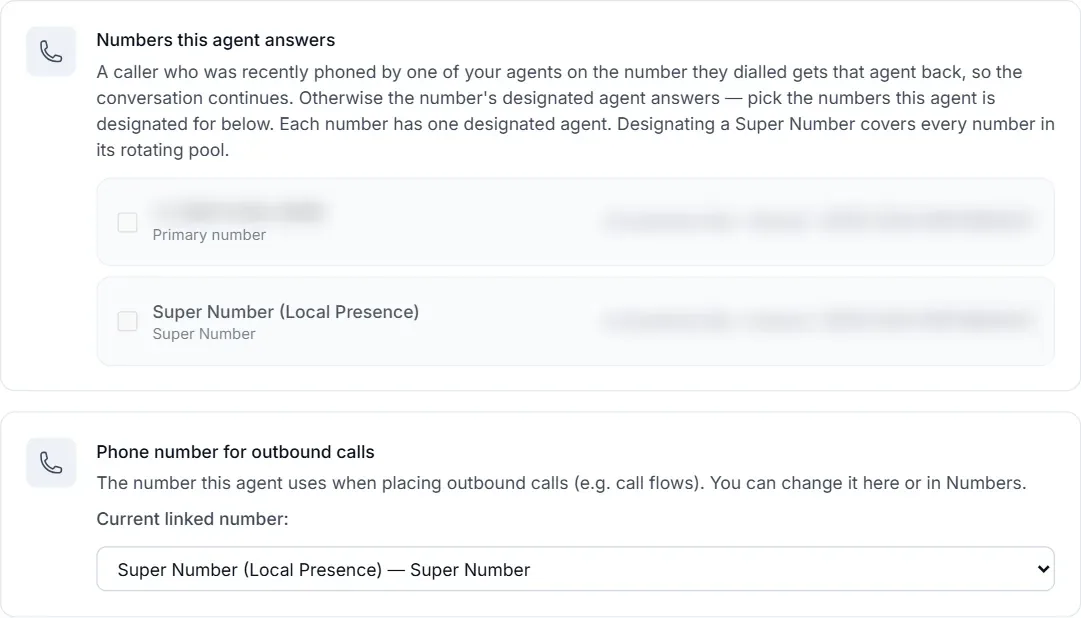
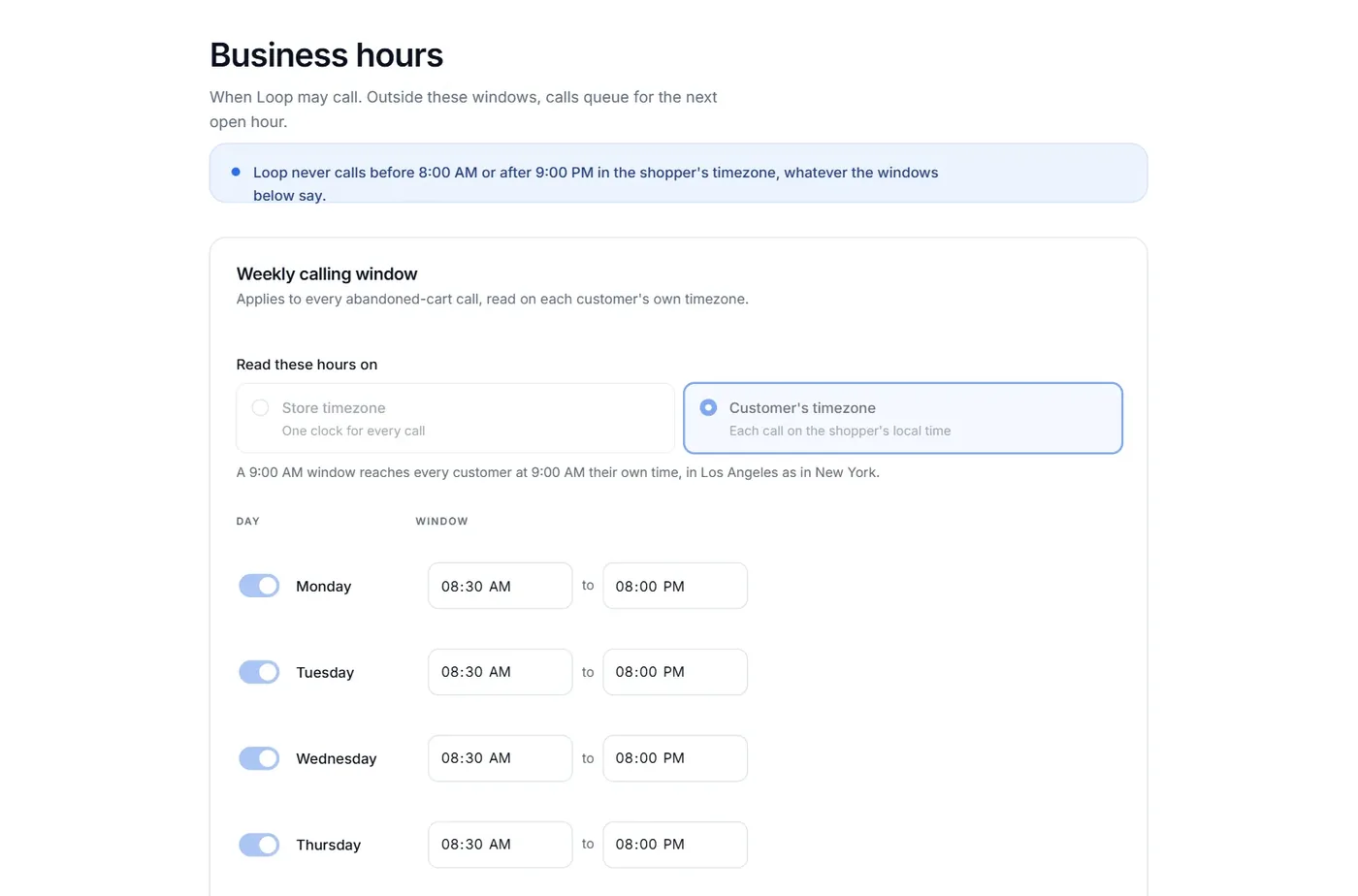
Hours. A weekly calling window is read on either the store's clock or each shopper's own time zone, with a separate window for the agent's outbound calls. Above both sits a hard floor: Loop never calls before 8:00 AM or after 9:00 PM in the shopper's time zone, whatever the windows say. That matches the federal telemarketing hours in 47 CFR 64.1200, but not Florida's and Oklahoma's 8 PM cut-off, which you still have to set yourself.
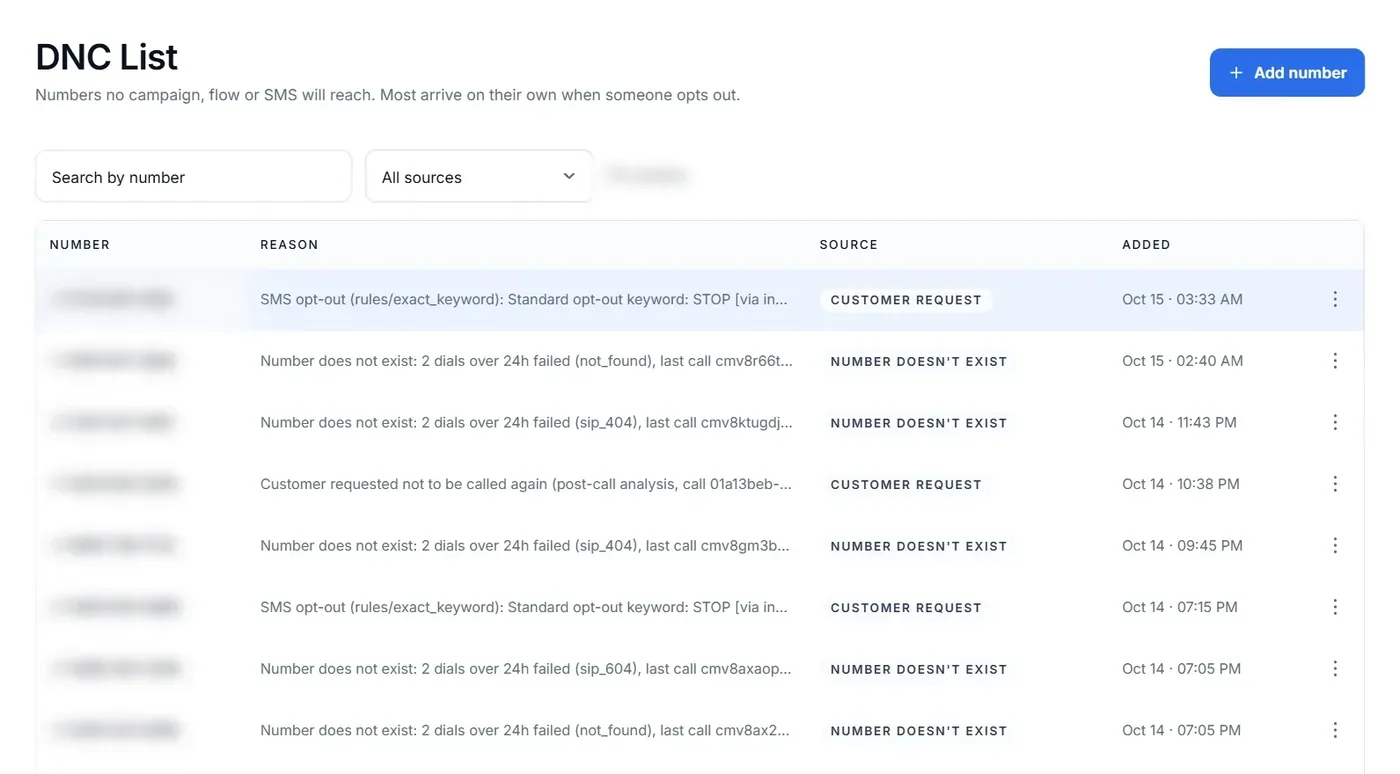
Opt-outs. The do-not-call list fills itself: an SMS reply with a STOP keyword, a shopper who says on the call that they don't want to be called again (picked up by the post-call analysis), negative call sentiment, regulatory blocks and numbers that failed twice in 24 hours all land here, and you can add numbers by hand. Nothing in a flow, campaign or text reaches a listed number.
What the agent can look up
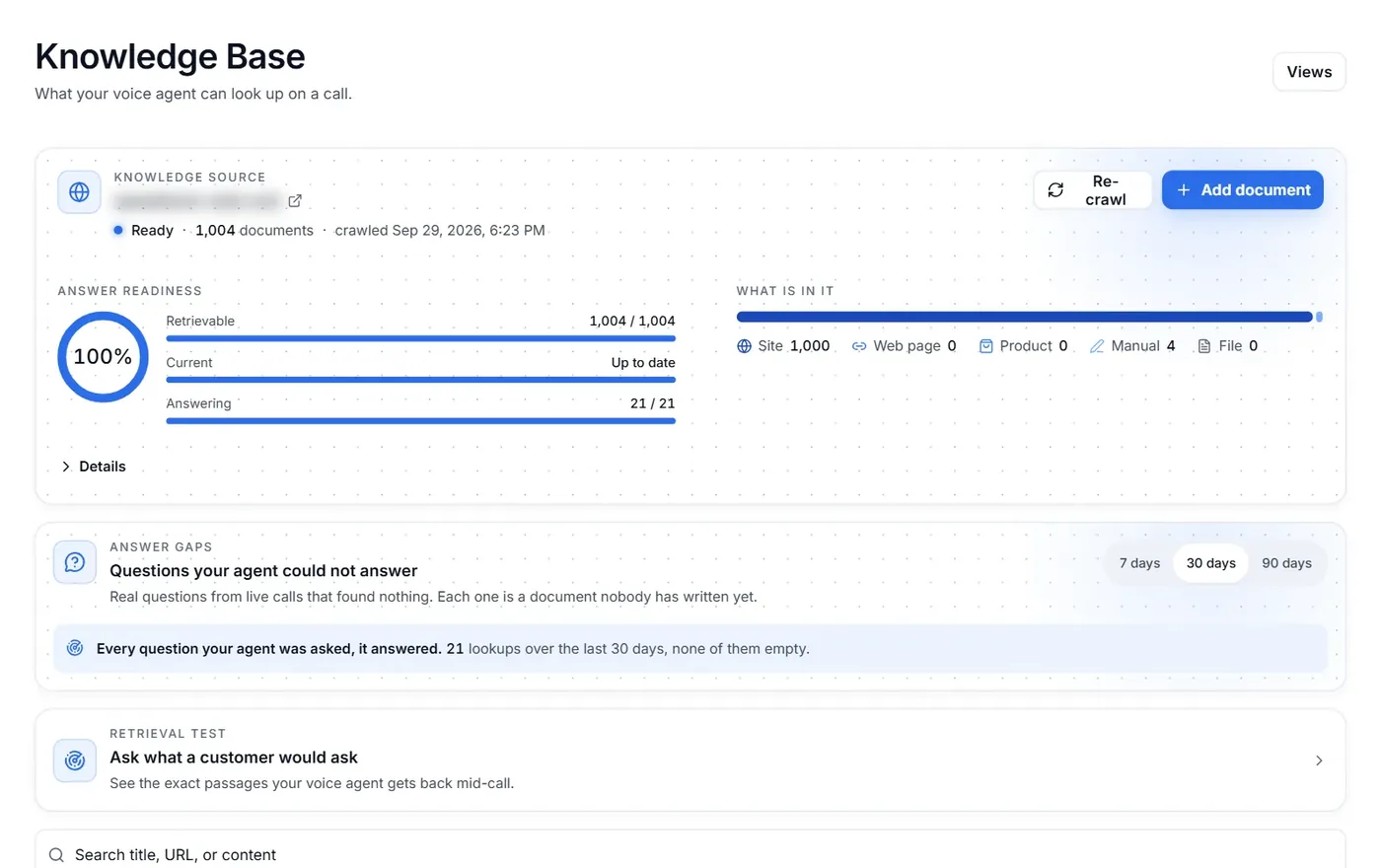
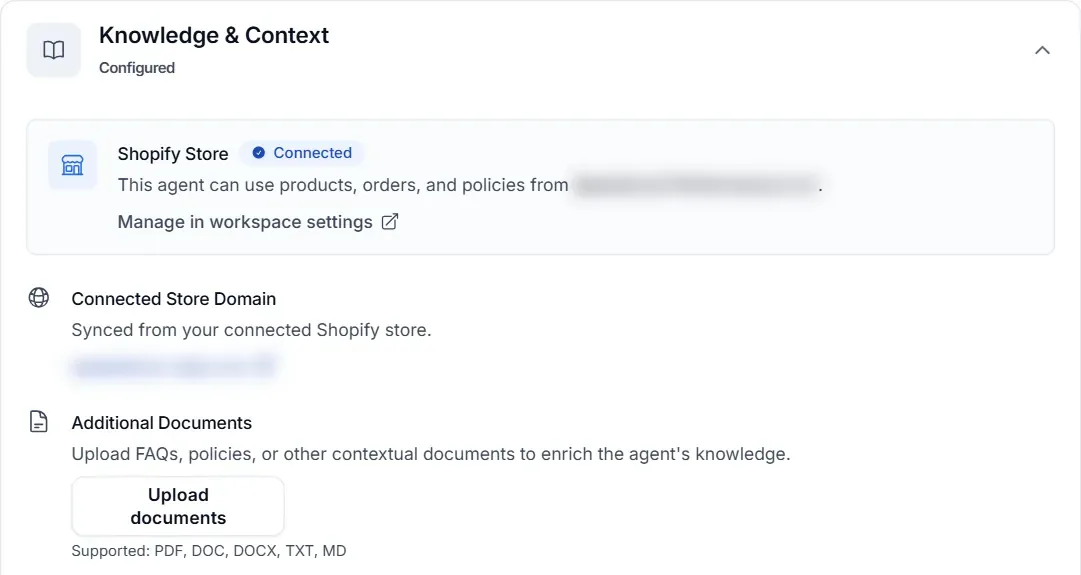
The knowledge base crawls the store's site (about a thousand pages in this workspace), syncs products, orders and policies from the connected Shopify store, and accepts uploaded PDF, DOC, DOCX, TXT and MD files plus short notes. A readiness panel shows how many documents are retrievable, current and answering. An “answer gaps” list collects real questions from live calls that found nothing in the knowledge base, each one a document somebody still has to write, and a retrieval test shows the exact passages the agent would get back mid-call.
What it costs
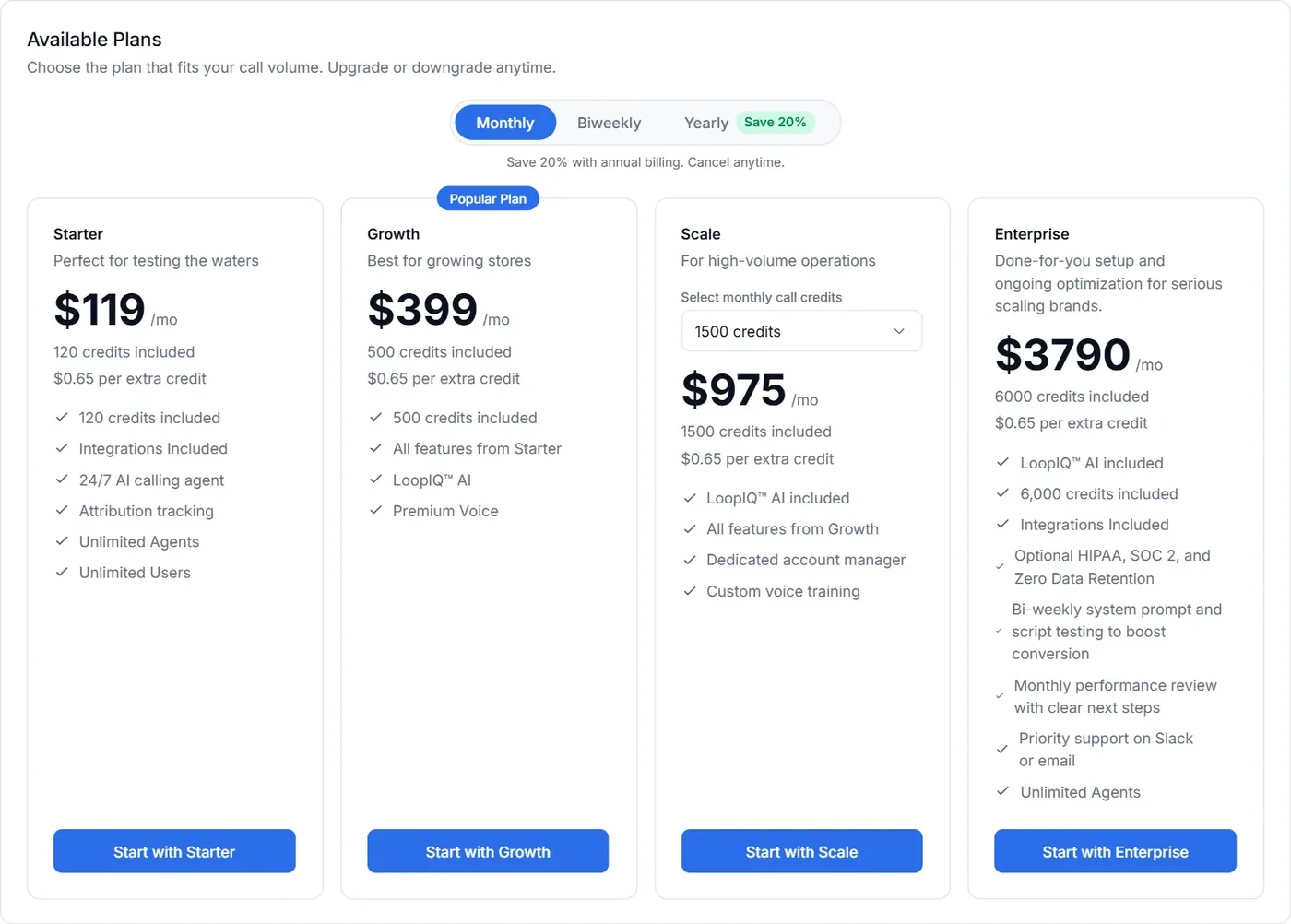
The plans inside the app match the public pricing page: Starter $119 a month for 120 credits, Growth $399 for 500, Scale $975 for 1,500 (a menu lets you pick more), Enterprise $3,790 for 6,000. Three things the public page doesn't say, all seen in the app on 15 October 2026:
- Extra credits cost $0.65 each on every plan.
- Credits expire. Monthly plan credits expire 60 days after they're granted, and the oldest credits are used first.
- Credits scale with talk time. The pricing page says an answered conversation uses about 1.5 credits; in the call records we saw, one 20-minute answered call was charged 11.3 credits. Texts and the Loop IQ copilot use credits too, each tracked as its own category.
Billing can be monthly, every two weeks or yearly at 20% off. Growth adds the Loop IQ copilot and premium voices; Scale adds a dedicated account manager and custom voice training; Enterprise adds optional HIPAA, SOC 2 and zero-data-retention terms, prompt and script testing every two weeks, a monthly performance review and priority support on Slack or email. Call recordings are kept for up to seven days.
At $119 for 120 credits, about 80 answered conversations by Loop's own figure, a store that recovers 5% of the shoppers it reaches pays about $30 per recovered order on the Starter plan, before the cost of texts. The pricing page advertises a guarantee of 4× the plan cost recovered in the first month, or the next month free; Loop Voice told us by email that it applies to qualifying brands only, about 17% of those that apply.
Testing before real calls
Two ways to hear the agent without dialing a shopper. The test console on the agent page calls your own phone; it uses credits, and the calls are kept out of the analytics. The Simulator runs saved practice conversations between an agent and AI-played customers, each scored out of 10 by an AI judge with a pass rate across runs; it uses no credits and dials no real number. A simulation can check, for example, that the agent never promises a transfer it can't make, never demands an email address and never guarantees a pickup time.
We haven't made a test call ourselves yet. When we do, the results go on this page.
Integrations and the copilot
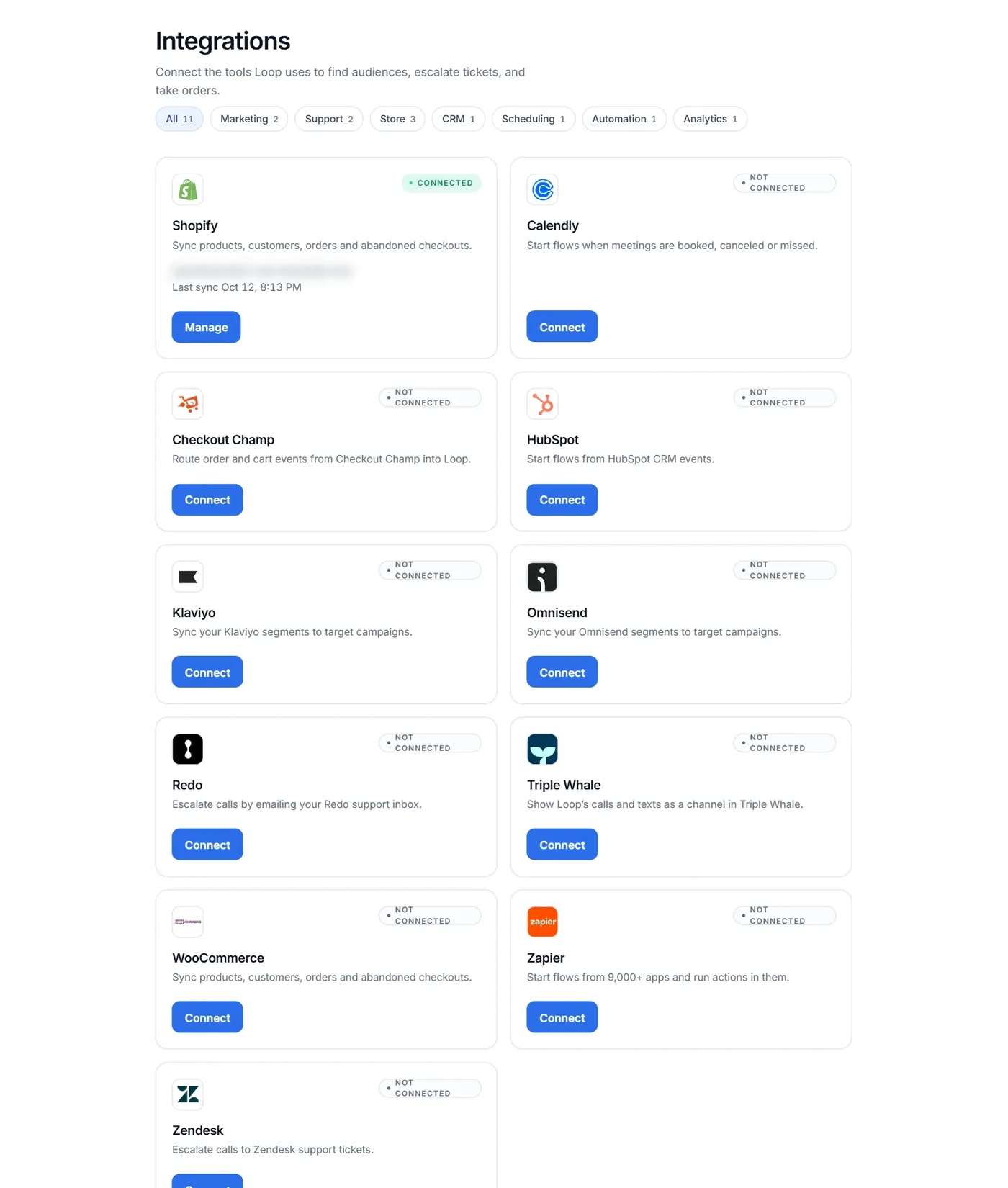
Eleven integrations: Shopify, WooCommerce and Checkout Champ for the store; Klaviyo and Omnisend for marketing; Zendesk and Redo for support; HubSpot as CRM; Calendly for scheduling; Zapier for automation; Triple Whale for attribution.
Loop IQ is a chat copilot over the workspace: it reads agents, campaigns, flows, calls and spend, answers with the real numbers, and can run A/B tests and make changes, which you approve one by one. It is read-only by default; an “Act” mode turns suggestions into change cards. “Loops” are the suggestions themselves: the system listens to the store's own calls and sends the merchant weekly changes to accept or decline, which Loop Voice describes as the agent improving itself (by email, 15 October 2026). In this workspace the panel showed three pending suggestions “backed by your own calls”. The Campaigns page uses the same data to propose outbound lists, such as early access for repeat buyers or a win-back, with a projected number of orders per credit.
Who it's for
- Good fit: a Shopify store with enough abandoned checkouts to use 80 or more answered conversations a month, products people have questions about (fitment, sizing, shipping, returns), and a US customer base whose checkout collects phone consent for calls.
- Check first: the consent box on your checkout (a texting opt-in is not an opt-in for AI calls; see the calling rules), the state cut-offs for Florida and Oklahoma, and how many credits your calls really use once you've run a week.
- Look elsewhere if you want a flat per-lead price with email and WhatsApp included, or a share-of-recovered-sales deal: both are in our cart-calls comparison.
What Loop Voice says that we could not check
Three claims came from Loop Voice by email on 15 October 2026, after it had read a draft of this page. It says it runs only frontier AI models, nothing open-source, which it believes costs a little more per call than some rivals and converts better. It says the Super Number roughly doubles pickup rates. And it puts the abandoned-cart conversion rate across the whole platform since launch at 11%, the same figure its customer page gives for one store. We report these as the vendor's numbers; our own test calls and any verified store results will be added here.
Questions store owners ask
Does Loop Voice call at night?
No. The app never calls before 8:00 AM or after 9:00 PM in the shopper's own time zone, and you can narrow that further per day. Florida and Oklahoma stop at 8 PM; set that window yourself.
Can I use my own phone number?
Yes. You can import numbers from Twilio or connect a SIP trunk (Twilio, Vonage, Telnyx). Buying a number from Loop costs 7 credits. Free accounts get one number; paid plans up to ten.
What is a credit?
About 1.5 credits per answered conversation, by Loop's pricing page. Calls nobody picks up aren't charged, long calls cost more (a 20-minute call we saw cost 11.3 credits), texts and the copilot use credits too, extra credits are $0.65, and monthly plan credits expire after 60 days.
Does it work outside Shopify?
The app lists WooCommerce and Checkout Champ as store integrations, HubSpot as a CRM, Calendly, Zapier, Klaviyo, Omnisend, Zendesk, Redo and Triple Whale. The flow trigger accepts HubSpot, Calendly and Zapier events, a manual list, an API call or a CSV.
Can I test it without calling customers?
Yes. The Simulator runs practice calls against AI-played customers and scores them, with no credits and no real numbers. The test console calls your own phone and uses credits.
What stops the AI from inventing a discount?
A “Never Hallucinate” compliance rule, a per-agent list of the only discount codes it may use, and a knowledge base built from the store's own pages, policies and documents. We haven't tested how well these hold up on a live call yet.
Sources and method
- Loop Voice app (app.loopvoice.ai), a live customer workspace Loop Voice opened for us; screens read and captured on 15 October 2026. We changed no settings, placed no calls and ran no flows or campaigns. Store name, people, phone numbers, web address and results are withheld or blurred.
- Loop Voice pricing, abandoned-cart and Shopify App Store pages (vendor-published), checked 13 and 15 October 2026
- Loop Voice by email, 14 October 2026, on the free Shopify plan and the conditions of the 4× guarantee; and 15 October 2026, after reading the draft, on the Super Number pickup rate, Loops, its model choice and the 11% platform-wide rate
- 47 CFR 64.1200 (eCFR), for the 8 AM to 9 PM federal calling hours