AI receptionist laws: recording consent, AI disclosure and callbacks
When an AI answers your business phone line, three rule groups come into play: permission to record the call, notifying callers that they are talking to an AI, and obtaining consent before the AI calls anyone back. Here is what each requires as of November 2026, along with the relevant laws and a greeting that satisfies the most stringent of them.
Many AI receptionists capture and transcribe each call, and the most effective ones can sound human. The laws on this page focus on those two realities. You’ll find the federal rules and the state statutes that apply when an AI answers a phone call, with links to the underlying text, along with what we observed in the AI receptionists we tested. This is a summary for business owners, not legal advice.
The short version
- Recording. Under federal law, only one participant’s consent is required, yet 13 states require the consent of everyone on a phone call, and an AI line receives calls from all of them. At the beginning of each call, state that it is being recorded. (18 U.S.C. 2511; RCFP)
- AI disclosure. It is mandatory in Maine any time a caller might confuse the AI with a human. In Utah, it is needed when the caller asks, and it must also be given at the outset of high-risk calls involving licensed professions. California imposes an additional requirement for companies that have more than $500 million in revenue, effective 1 January 2027. (the laws)
- Callbacks. Under federal robocall law, an AI voice is treated as an artificial voice, which means you need the person’s prior consent before the AI calls a cell phone and written consent for marketing calls, and the AI must identify your business at the beginning of the call. (FCC 24-17; 47 CFR 64.1200)
In most other states, there is still no legal requirement for an AI receptionist to disclose that it is artificial intelligence. Even so, including that disclosure only takes one sentence, and the greeting below provides it. (IBTimes, 21 September 2026)

Recording consent: one party or everyone
Under the federal Wiretap Act, a call may be recorded if one participant has consented, and the majority of states apply that standard. The Reporters Committee for Freedom of the Press identifies 11 states that generally insist on consent from all parties: California, Delaware, Florida, Illinois, Maryland, Massachusetts, Michigan, Montana, New Hampshire, Pennsylvania and Washington. Connecticut and Nevada require everyone’s consent for telephone calls. (18 U.S.C. 2511(2)(d); RCFP)
In Oregon, all participants must agree only when the exchange happens face to face, which means that a phone call there requires just one party’s consent. Hawaii and Maine impose that requirement solely in especially private locations. Vermont has no recording statute of its own, so the federal rule governs there. (RCFP)
When the person calling and your company are located in different states, courts do not agree on which state’s law governs, and the RCFP recommends presuming that the more restrictive law controls. Because an AI receptionist may handle calls from all 50 states, the safest approach is to regard every call as one requiring consent from all parties.
AI raises a separate issue: was the AI company actually participating in the call, or merely an outside listener? In Taylor v. ConverseNow, a caller placed an order with a Domino’s location whose phones were handled by ConverseNow’s AI, which identified itself as a store employee. In August 2025, a federal court in California allowed her privacy claims to proceed, treating the AI company as a third party because it could use the calls to refine its own product. This was an early ruling on her allegations, not a final judgment. (Taylor v. ConverseNow, N.D. Cal., 11 August 2025)
The RCFP says Michigan’s all-party rule covers, at a minimum, recordings made by a third party who is not part of the conversation. Accordingly, the greeting should state that the call is being recorded and that an AI service is answering it, and you should review your vendor’s terms to see what they permit it to do with your recordings.
AI disclosure: the states that require it
Laws in three states extend to phone calls handled by AI. By contrast, the older bot statutes in California and New Jersey apply only to online accounts, and Colorado’s 2026 revision of its AI law removed the broad disclosure requirement.
Maine
- Who it covers
- Any person who employs an AI chatbot or any other computing technology in transactions with consumers
- In force
- Yes (Public Law 2025, chapter 294)
What it requires. A clear and conspicuous disclosure that the caller is not interacting with a human, whenever a reasonable consumer could otherwise be misled. Any such breach is treated as a breach of the Maine Unfair Trade Practices Act.
Utah
- Who it covers
- Consumer-facing businesses employing generative AI, including voice-based use, and licensed occupations overseen by the Department of Commerce
- In force
- Since 7 May 2025
What it requires. State that it is AI whenever the caller directly asks. For any high-risk voice call, licensed professionals must disclose the AI at the outset: this includes calls involving the collection of health, financial, or biometric data, as well as the provision of financial, legal, or medical advice. A disclosure made at the beginning and maintained throughout the call is a safe harbor. Fines may reach $2,500 for each violation (13-77-104 and 105).
California
- Law
- AB 1609, Business and Professions Code 22625 to 22629 (bill record)
- Who it covers
- Companies that generate over $500 million in total yearly revenue across the country and provide services to customers residing in California
- In force
- From 1 January 2027; signed 28 September 2026 (HLC)
What it requires. Do not portray the AI as a human being. If a reasonable person could be misled, clearly state in the same medium that it is AI. When the business is open, allow callers to request a live agent, and in good faith try to put them through within 15 minutes or arrange a callback within one business day. A first violation may result in a penalty of up to $5,000, and each subsequent violation may bring $10,000.
California’s regulation applies only to very large companies, yet callers everywhere want the same thing. In a Gartner survey of 5,728 customers, 64% said they would rather companies not use AI for customer service, and their main concern was being unable to reach a human. (Gartner)
Laws that do not reach a phone call
California and New Jersey bot laws. California requires disclosure when a bot is used to deceive someone into making a purchase or casting a vote. In New Jersey, if a bot is used to market merchandise or real estate, the disclosure must appear at the beginning. In both states, a bot is defined as an automated online account, so neither law covers a phone call (Cal. B&P Code 17940; N.J.S.A. 56:18-1 and 56:18-2).
Colorado. In May 2026, Colorado repealed and replaced its 2024 AI Act. Beginning 1 January 2027, the new statute applies to automated decision technology employed in consequential decisions, including lending, housing, insurance, and employment, while language systems used solely to supply information are excluded (SB 26-189; signed 14 May 2026).
The chatbot laws enacted in 2026 in states including Connecticut, Rhode Island, New York, and Washington chiefly target AI companions and minors rather than receptionists. For instance, Rhode Island’s version leaves out systems used only for customer service. (FPF 2026 chatbot legislation tracker; Rhode Island S 2195)
Laws read on each legislature's site or the bill's record, 20 November 2026. A summary, not legal advice.
When the AI calls people back
Answering calls is inbound work. The rules change when the AI places a call, for instance to return a missed call, pursue a lead, or verify an appointment. In February 2024, the FCC determined that AI-generated voices count as artificial voices under the Telephone Consumer Protection Act. (FCC 24-17)
Thus, an AI-initiated call to a cell phone requires the person’s prior express consent, while an AI marketing call to either a cell phone or a home line requires prior express written consent. In addition, every artificial-voice message must state the business’s name at the start and provide a phone number during or after the message. (47 CFR 64.1200(a) and (b))
California uses a separate rule for automatic dialing-announcing equipment: beginning in 2025, the live announcement before a recorded message has to state whether the message is using an artificial voice, meaning a voice generated or significantly altered with AI. In 2024, the FCC put forward a proposal that would require AI-generated calls to include a disclosure; as of 20 November 2026, the Federal Register still listed that proposal and no final rule. (California AB 2905; Federal Register)
What the AI receptionists we tested do
For our reviews, we configured three AI receptionists. Here is what each of them provides on these points.
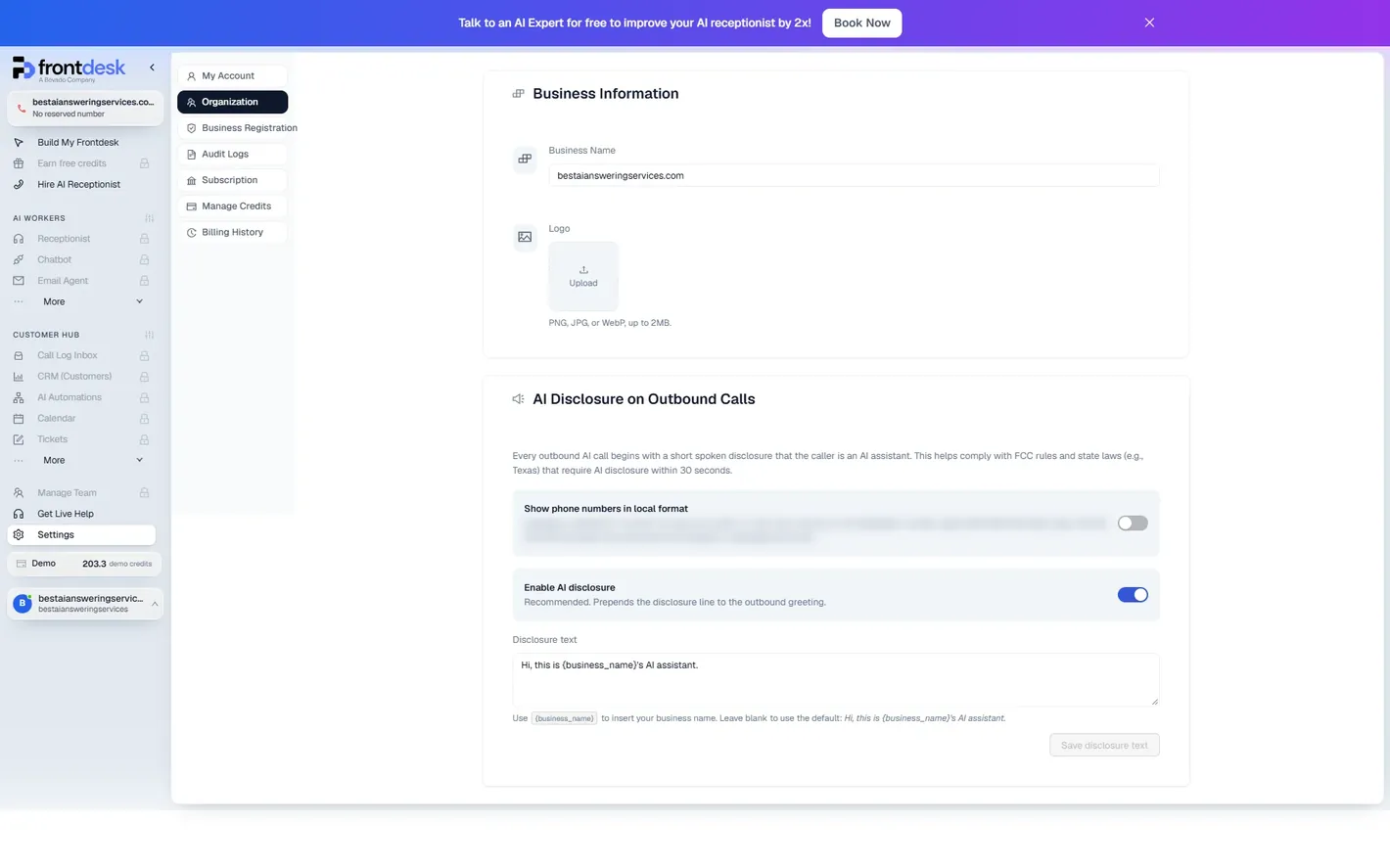
- My AI Front Desk. My AI Front Desk includes an AI disclosure option for outbound calls, enabled by default, that begins every call with a spoken statement identifying the caller as an AI assistant; the exact phrasing can be edited. The accompanying note connects this to FCC rules and state laws, and it specifically mentions Texas. (our review)
- KaiCalls. On our line, the KaiCalls greeting identified the agent by name, Kai, but did not state that it was an AI. Its directions required it to respond honestly to the question “Are you an AI?”, and the call page indicates whether any disclosure occurred. That aligns with Utah’s standard when the caller asks; under Maine’s standard, the disclosure should appear in the greeting. (our review)
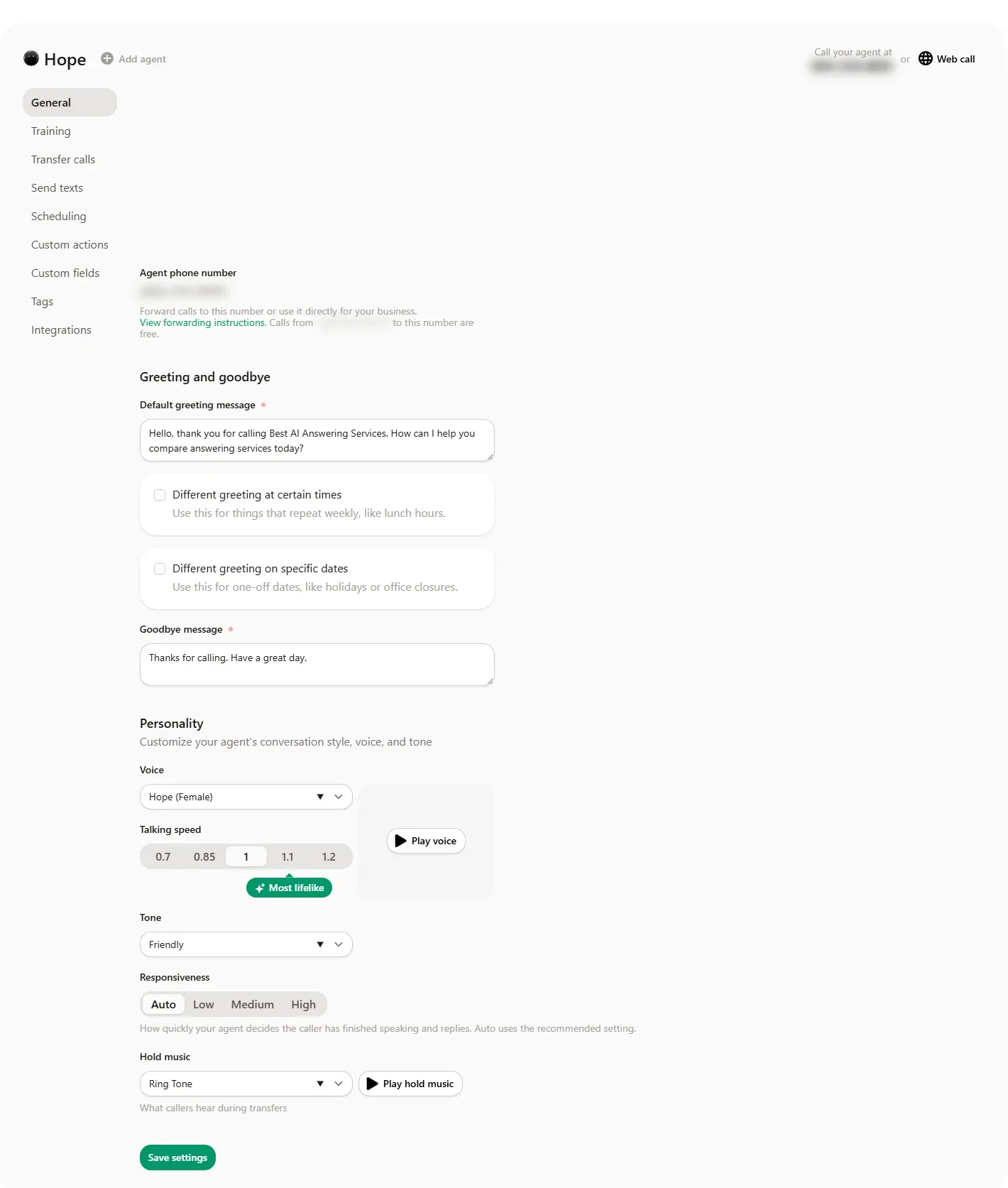
- Upfirst. Upfirst allows you to compose both the opening greeting and the closing farewell, and to configure distinct greetings based on time or date. Its transfer settings make it possible to capture either only the AI portion of a transferred call or the complete call, which is important when the recipient of the transfer is located in an all-party state. (our review)
A greeting that covers recording and AI disclosure
A greeting that satisfies the strictest rules above takes roughly ten seconds:
“Thanks for calling [business]. I’m [business]’s AI assistant, and this call is recorded. I can schedule a visit, take a message, or connect you with the team. How can I help?”

After that, include three items in the AI instructions: respond honestly if asked, “Are you a real person?”; whenever someone requests a person, either connect the call or take a message; and if anyone prefers not to be recorded, provide a callback option.
When the AI makes outbound calls, include the consent language on the forms where leads submit their phone number, and retain documentation of that consent.
Our free voicemail greeting generator can create an English or Spanish message for your own voicemail or after-hours line.
Questions owners ask
Do I have to tell callers they are talking to an AI?
In Maine, yes, whenever a caller might confuse it with a human being. In Utah, it is required when a caller asks, and also at the outset of high-risk calls for licensed professions. In California, businesses with annual revenue exceeding $500 million must do so beginning 1 January 2027. In most other states, there is not yet any law mandating this, though a single sentence in the greeting meets these disclosure rules.
Is it legal for an AI receptionist to record calls?
Yes, if consent is given. Under federal law, and in most states, only one participant’s consent is required; however, 13 states require consent from every person on a phone call. At the beginning of the call, state that it is being recorded and that an AI service is answering it. This is general information and not legal advice.
Does California's AB 1609 apply to my small business?
It applies only to businesses with annual gross revenue above $500 million nationwide. Beginning on 1 January 2027, it will require an AI disclosure in situations where callers might be misled, as well as a method to contact a human agent during business hours.
Can my AI receptionist call leads back?
Yes, provided there is consent. Under the TCPA, the FCC classifies AI-generated voices as artificial voices. As a result, you need prior express consent before the AI places a call to a cell phone, and prior express written consent is required for marketing calls. In addition, your business must be identified at the beginning of the call.
What should an AI receptionist greeting say?
State your business name, say that the caller is talking to an AI assistant, note that the call is being recorded, and explain how to reach a person. For instance: “Thanks for calling [business]. I’m [business]’s AI assistant, and this call is recorded. I can schedule a visit, take a message, or connect you with the team.”
Sources
- Recording: 18 U.S.C. 2511; Reporters Committee for Freedom of the Press, Reporter's Recording Guide; Taylor v. ConverseNow Technologies, No. 25-cv-00990-SI (N.D. Cal., order of 11 August 2025)
- AI disclosure: Maine, 10 M.R.S. §1500-DD; Utah Code 13-77-101 (effective 6 May 2026), 13-77-103 (effective 7 May 2025) and chapter 77; California AB 1609, Chapter 733, Statutes of 2026 and HLC's summary; California B&P Code 17940; New Jersey P.L. 2019, c. 486; Colorado SB 26-189 and Davis Wright Tremaine's summary; Future of Privacy Forum, 2026 chatbot legislation tracker; Rhode Island S 2195 Sub A (2026); IBTimes, 21 September 2026; Gartner, 9 July 2024
- Callbacks: FCC 24-17, 8 February 2024; 47 CFR 64.1200 (edition of 1 October 2025); California AB 2905, Chapter 316, Statutes of 2024; FCC proposed rule, Federal Register, 10 September 2024
- Our own test accounts: My AI Front Desk and Upfirst (16 October 2026), KaiCalls (19 October 2026)
- All laws read 20 November 2026. This page is a summary for business owners, not legal advice.