Cart abandonment software is any tool that brings a shopper back to a checkout they left: the emails your store already sends, text and push flows, the popup that fires when the cursor heads for the close button, people who text, and AI agents that call. Baymard Institute puts the average documented cart abandonment rate at 70.22% across 50 studies (Baymard), so for most stores the carts left behind outnumber the orders two to one. This guide sorts the tools into five kinds, shows what each kind recovers and what it costs on the vendors' own pricing pages (checked 16 October 2026), and gives the order to add them in. Our AI abandoned cart calls guide covers the calling tools in depth; this page is the map.
Some vendors on this page, Outcraft AI among them, pay us a commission if you sign up through our links. It doesn't change the order: the free and cheap tools come first because that is the order to use them in. How we compare.
What cart abandonment software does
A shopper adds something to the cart, starts checkout, and leaves. Three things can bring them back: a reason to return (the answer to the question that stopped them, or a nudge), a way back (a link that reopens the same cart), and timing (minutes for a call, hours for a text, a day for an email). Every tool on this page is a different mix of those three. The store has to capture something first: an email address or a phone number, usually at the first step of checkout, and for texts and calls, the shopper's consent.
What the software cannot do is fix the reason most shoppers leave. In Baymard's surveys of US shoppers who abandoned for a reason other than browsing, about four in ten left because of extra costs such as shipping, tax or fees, and about one in five each because delivery was too slow, they didn't trust the site with their card, or it wanted them to create an account (Baymard). A text can't lower your shipping price. Fix the checkout first, then recover what's left.
The five kinds of cart abandonment software
| Kind | What it does | What you need | Examples |
|---|---|---|---|
| 1. The store's own automation | Sends an abandoned-checkout email, free, once you switch it on | The shopper's email | Shopify: abandoned checkout emails are free and do not count toward Shopify Email's monthly limit; WooCommerce and BigCommerce have equivalents |
| 2. Email, SMS and push flow tools | Multi-step sequences: email at 1 hour, text at 4 hours, push the next day, each with the cart link; browse-abandonment too | Email, phone number with SMS consent, or a push subscription | Klaviyo, Omnisend, Privy, Postscript (SMS), Recart (SMS, managed), PushOwl (web push), CartStack |
| 3. On-site cart savers | A popup when the cursor leaves the page or the shopper idles, with an offer or a save-your-cart email field | Nothing: it works on anonymous visitors | OptinMonster, Privy pop-ups, the popup builders inside Klaviyo and Omnisend |
| 4. People who text | Agents text the shopper by hand, answer questions and send the link | Phone number and SMS consent | SMS Troopers, CartConvert |
| 5. AI calls | An AI voice agent phones the shopper within minutes, answers what stopped the order, texts the link | Phone number and consent to AI calls | Callsy, Ava AI, Conversa, Loop Voice, Outcraft AI; see the calls guide |
Most stores end up with three of the five: the store's own email, one flow tool for texts and more emails, and either a popup or a calling tool depending on order size. The sixth thing, a human call center, costs $25 to $35 an hour per agent in the US and is covered in the calls guide.
What each kind recovers
Only email has independent-scale numbers. Klaviyo's analysis of more than 143,000 abandoned-cart email flows sent in 2023 found that 3.33% of recipients placed an order on average and 7.69% at the top 10% of brands (Klaviyo); its November 2025 benchmark puts the average at 2.68% (Klaviyo). Those are shares of the shoppers who received the email, and Klaviyo sells email and SMS.
| Kind | Published result | Whose figure |
|---|---|---|
| Store's own email | No vendor benchmark; the same mechanism as a flow tool's first email | |
| Email flows | 2.68% to 3.33% of recipients order; 7.69% at the top 10% of brands | Klaviyo, across its customers |
| SMS flows | Carriers allow one abandoned-cart text per cart within 48 hours, to double opted-in subscribers; no cross-vendor order rate is published | Klaviyo help center |
| Web push | No cross-vendor benchmark published | |
| On-site popups | Conversion of the popup itself, not of the cart; vendors publish examples, not averages | |
| People who text | Paid as a share of recovered sales, which is the only published measure | SMS Troopers, CartConvert |
| AI calls | 14% to 32% of called carts in the vendors' own case studies; no independent study | Outcraft, Callsy, Loop Voice |
Email and call figures are not measured the same way: Klaviyo counts orders per recipient of the email; the calling vendors count orders per shopper called, and they choose which shoppers to call. The only way to compare them for your store is a holdout test.
The honest summary: emails reach everyone and bring back a few percent; calls reach the shoppers who left a phone number and consent, and bring back a larger share of a smaller group, at a higher cost per shopper. The two don't compete; the question is which carts are worth the second tool.
What cart abandonment software costs
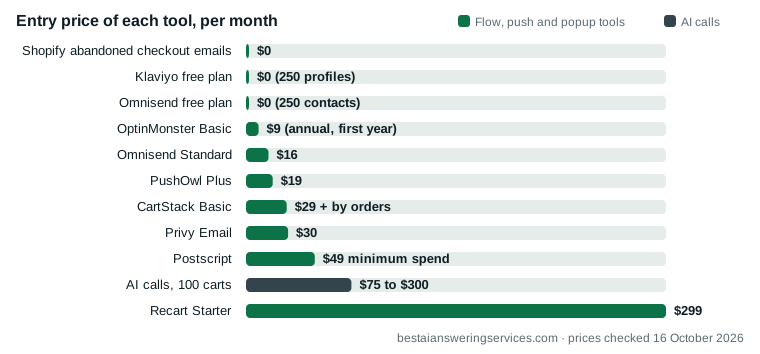
| Tool | Kind | Entry price | What it covers | Trial |
|---|---|---|---|---|
| Shopify abandoned checkout emails | Store's own | $0 | Automatic email with the checkout link; doesn't count toward Shopify Email's monthly limit | Included |
| Klaviyo | Email, SMS, push flows | $0 | Free plan: up to 250 profiles, 500 emails a month, $5 of mobile messages a month; paid plans priced by active profiles | Free plan |
| Omnisend | Email, SMS, push flows | $0, then $16 | Free: 250 contacts, 500 emails a month, pre-built cart abandonment workflow included; Standard $16 a month for 500 contacts and 6,000 emails; Pro $59 for 2,500 contacts, SMS from $0.007 a message; 30% off for three months prepaid | Free plan |
| Privy | Email and SMS, popups | $30 | Email $30 a month priced by mailable contacts, unlimited sends, with an SMS add-on and 250 SMS credits; pop-ups only from $24 a month by page views | 15 days, no card |
| Postscript | SMS flows | $49 minimum | $0 a month with a $49 monthly minimum spend; abandoned cart texts to opted-in subscribers | |
| Recart | SMS, managed | $299 | Starter $299 a month with 23,000 texts at $0.01 each; Pro $499, Scale $999; a dedicated SMS professional above Starter; demo, no trial listed | Demo |
| PushOwl + Brevo | Web push and email | $0, then $19 | Basic $0 for 500 pushes a month without cart automation; Plus $19 for 10,000 pushes with abandoned cart automation; Power $79 for 25,000 | Free plan |
| CartStack | Email, SMS, push, browse abandonment | $29 | Basic $29 and Pro $49 base, scaled by your monthly orders: $39 and $69 at 100 orders, $219 and $299 at 1,000; no overage; rev-share on request | 14 days, no card |
| OptinMonster | On-site popups | $9 | Basic $9 a month for 2,500 impressions on an annual plan at introductory pricing ($210 a year on renewal); Exit-Intent on Pro, $37 a month for 25,000 impressions ($870 a year on renewal) | |
| SMS Troopers | People who text | Share of sales | 20% of recovered sales on the free plan, down to 5% at $299 a month | Free plan |
| CartConvert | People who text | $0, then $49 + 5% | Free for 5 recovered checkouts a month, then $49 a month plus 5% | Free plan |
| Callsy | AI calls | $0, then $29 | 20 free calls once, then $29 a month for 50, $99 for 200, $199 for 500 on its Shopify listing | 20 free calls |
| Ava AI | AI calls and support line | $99 | Recover plan: 400 minutes, then $0.08 a minute; about $227 for 1,000 two-minute calls | 7 days |
| Conversa | AI calls | $0.75 a call | No monthly fee; Pro $499 a month plus $0.35 a call | |
| Loop Voice | AI calls | $119 | 120 credits, about 80 answered conversations at 1.5 credits each; $975 for 1,500 credits; see our review from inside the app | Shopify installs only |
| Outcraft AI | AI calls, texts, email, WhatsApp | $300 | Up to 100 leads a month, every channel included; $2,000 for 751 to 1,000 | Free plan or trial; its pages differ |
Flow, push and popup tools from their pricing pages, checked 16 October 2026; the people-who-text and AI-call tools from their pricing pages and Shopify App Store listings, checked 1 October 2026 (Loop Voice 15 October 2026). Klaviyo's US pricing page shows paid plans by profile count rather than a single entry price. OptinMonster's monthly figures are annual-plan introductory prices.
Two things the table hides. Flow tools charge by list size, so a store with 20,000 profiles pays a few hundred dollars a month for Klaviyo or Omnisend whatever it recovers, while a calling tool charges only for the carts it works. And the percentage-of-sales tools (SMS Troopers, CartConvert, Callfy) are cheap at low volume and dear at high; at $50,000 a month of recovered sales, 5% is $2,500.
How to stack them: the order that keeps the cost per cart low
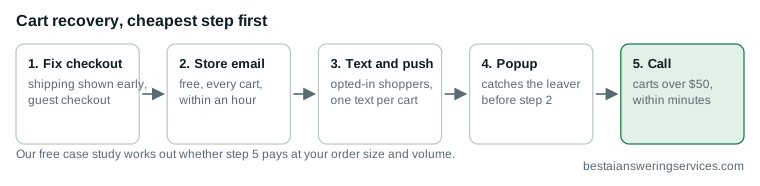
- Fix the checkout. Show shipping and tax before the checkout page, allow guest checkout, offer a second payment method. Baymard's reasons above are the list; each one you remove shrinks the pile every tool below works on.
- Switch on the store's email. It is free and reaches every cart with an email address. Set the delay to an hour, not ten minutes, so you don't email people who are still paying.
- Add texts and push for opted-in shoppers. Omnisend's free plan or Klaviyo's includes the cart flow; PushOwl's $19 plan adds push for visitors who never typed an email. Carriers allow one abandoned-cart text per cart, within 48 hours, to shoppers who double opted in (Klaviyo).
- Add a popup if your traffic is anonymous. An exit-intent popup is the only tool that works before the shopper has given you anything. Measure it on the orders it produces, not on the emails it collects.
- Add calls for the carts worth it. Above about $50 an order and 50 abandoned checkouts a month, a call pays in the vendors' figures and in our free case study's arithmetic; below that, stop at step 4. Decide which carts get a call (a value threshold, a product line) so nobody gets a call, a text and an email about the same cart in the same hour.
Consent: what texts and calls need that emails don't
A summary, not legal advice. An abandoned-cart email needs an email address and a working unsubscribe link. A text needs the shopper's opt-in to marketing texts, which the flow tools collect at checkout or in a popup, and the carriers' rule of one cart text per cart within 48 hours. A call with an AI voice is telemarketing when it sells, and under the FCC's rules that takes the shopper's prior express written consent for calls made with an artificial voice (47 CFR 64.1200); the FCC ruled in February 2024 that AI-generated voices count (FCC 24-17). The consent wording goes on the checkout form, next to the phone field, before the first call. The calls guide has the current state of the rules, including the 2026 court decisions, and an example to show your lawyer.
Which to start with
- A new store, under 100 orders a month: the store's own email, then Omnisend's free plan for the text and a browse-abandonment email. Cost: $0.
- Growing, 100 to 1,000 orders a month, orders under $50: Klaviyo or Omnisend on a paid plan, PushOwl for push, and an exit popup. Skip calls.
- Orders over $50, or a product people have questions about: the flows above plus an AI caller on the high-value carts: Callsy to test for free, Loop Voice or Outcraft AI to run it. The calls guide compares them.
- No time to run it: Recart manages the SMS program for you from $299 a month; Outcraft AI runs the calls and messages for $300 a month for up to 100 leads.
Questions store owners ask
What is cart abandonment software?
Tools that bring shoppers back to a checkout they left: the store's own abandoned-checkout email, email and SMS flow tools such as Klaviyo and Omnisend, web push, exit-intent popups, people who text the shopper, and AI agents that call. Each needs something from the shopper first, an email, a phone number with consent, or a push subscription.
What is the best cart abandonment software?
Start with what is free: your store's abandoned checkout email and Omnisend's or Klaviyo's free plan for a text and a second email. Add PushOwl ($19 a month) for push and an exit popup if most visitors never give an email. For orders over $50, add an AI caller such as Callsy, Loop Voice or Outcraft on the high-value carts. There is no single best tool because each kind reaches a different group of shoppers.
What is the average cart abandonment rate?
70.22%, the average of 50 studies collected by Baymard Institute. Many of those shoppers were only browsing; among US shoppers who abandoned for another reason, about four in ten cite extra costs such as shipping, tax or fees.
How much does cart abandonment software cost?
From $0 (Shopify's own emails, Klaviyo's and Omnisend's free plans) to a few hundred dollars a month for a managed SMS program (Recart from $299). Flow tools charge by the size of your list; popup tools by impressions; AI callers per cart or per call, $75 to $300 a month for 100 carts; people who text take 5% to 20% of recovered sales. Prices checked 16 October 2026.
Does Shopify have abandoned cart recovery built in?
Yes. Shopify sends an abandoned checkout email automatically once you switch the automation on, and those emails are free: they don't count toward Shopify Email's monthly limit. It emails only shoppers who entered an email address at checkout.
What recovery rate should I expect from abandoned cart emails?
Klaviyo's benchmarks: 3.33% of recipients ordered on average across more than 143,000 flows in 2023, 7.69% at the top 10% of brands, and 2.68% in its November 2025 benchmark. Those are shares of the shoppers who received the email, not of all abandoned carts.
Can I text shoppers who abandoned a cart?
Only if they opted in to marketing texts, usually at checkout or through a popup, and the carriers' rules allow one abandoned-cart text per cart within 48 hours. Klaviyo, Omnisend, Postscript, Privy, Recart and CartStack all send them; SMS Troopers and CartConvert have people send them by hand.
Is it worth calling abandoned carts?
In the vendors' own case studies, 14% to 32% of called shoppers order, against a few percent for email, at $0.75 to $3 a call. The arithmetic works above about $50 an order and 50 abandoned checkouts a month; below that, email, text and push do the job for less. A call with an AI voice needs the shopper's prior express written consent in the US.
What is an exit-intent popup?
A message that appears when the cursor moves toward the browser's close button or the back button, or when a shopper idles, offering a discount, free shipping or a way to save the cart by email. OptinMonster sells it from $37 a month on its Pro plan; Privy, Klaviyo and Omnisend have popup builders too. It is the only tool that works on a shopper who hasn't given you an email or phone number.
What is browse abandonment?
A shopper looked at a product and left without adding it to the cart. The same flow tools send a browse-abandonment email or text to known shoppers; CartStack, Klaviyo and Omnisend offer it. It reaches more people than cart abandonment and converts fewer of them.
Should I offer a discount to recover a cart?
Not in the first message. A discount trains shoppers to abandon on purpose. Send the link and the answer to the likely question first (shipping cost, delivery date), and keep a discount for a second message or for the carts you call, where the AI can offer one only if your rules allow it.
Sources
- Klaviyo, Omnisend, Privy, Recart, PushOwl, CartStack and OptinMonster pricing pages (vendor-published), checked 16 October 2026; Shopify Help Center on Shopify Email costs; Klaviyo Help Center on SMS abandoned cart rules
- Postscript, SMS Troopers, CartConvert, Callsy, Ava AI, Conversa, Outcraft AI and Loop Voice pricing pages and Shopify App Store listings, checked 1 October 2026 (Loop Voice 15 October 2026); see the calls guide
- Baymard Institute, cart abandonment rate statistics (50 studies) and reasons for abandonment survey; Klaviyo abandoned cart benchmarks (2023 flows) and November 2025 benchmark
- 47 CFR 64.1200 (eCFR); FCC 24-17 (8 February 2024)