Missed call statistics (2026): unanswered business calls, voicemails and callbacks
Roughly 4 out of every 10 calls placed to businesses are never picked up by a live person, and the majority of those callers do not leave a voicemail. Below are the latest figures, along with each figure's source and date: industry-level answer rates, the timing of incoming calls, what callers do afterward, why return calls fall short, and the value of a missed call.
On 22 November 2026, we reviewed the original source for every figure on this page: call data from Invoca, CallRail, Quo, ServiceTitan and NextPhone; surveys conducted by Pew Research Center, the Census Bureau and others; and a 2026 study in Management Science. Because most of the call data is supplied by companies that sell phone or answering software, each figure identifies who measured it and in what way. The four well-known numbers that we were unable to link to a study appear at the end.
Key missed call statistics
- Across Invoca's 2026 benchmarks, which cover 70 million calls, a person answers 56% of calls to businesses; if calls under 15 seconds are excluded, that figure rises to 65%. (Invoca, July 2026)
- A live person answers 52% of calls to home-services companies, with rates varying from 32% to 74% among the different trades. (Invoca, July 2026)
- When a secret shopper placed calls, 40% of the 500 law firms answered, while 48% were unreachable by telephone altogether. (Clio, 2024 Legal Trends Report)
- Between July and September 2026, Quo's phone system recorded over 18 million missed calls, and 15% of callers chose to leave a voicemail. (Quo, 2 November 2026)
- In Quo's examination of 16.7 million missed calls, 69% of business calls that were missed did not receive a callback within 48 hours. (Quo, 20 August 2026)
- In ServiceTitan's data spanning May 2025 through July 2026, between 10.7% and 12.1% of calls to trades businesses came in after business hours, while residential HVAC peaked at 14.1% in June 2025. (ServiceTitan)
- 21% of US consumers report that if a call is not answered, they immediately contact a different business, while 78% say they have stopped doing business with a company after a call went unanswered. (CallRail, survey of 1,000 US consumers, September 2025)
- 80% of Americans say they usually do not pick up calls from unfamiliar numbers, so return calls are often left unanswered as well. (Pew Research Center, July 2020 survey)
- In a study analyzing 11.6 million Fiverr messages, responses delayed by one hour were associated with a 46% reduced likelihood of getting hired. (Management Science, 2026)
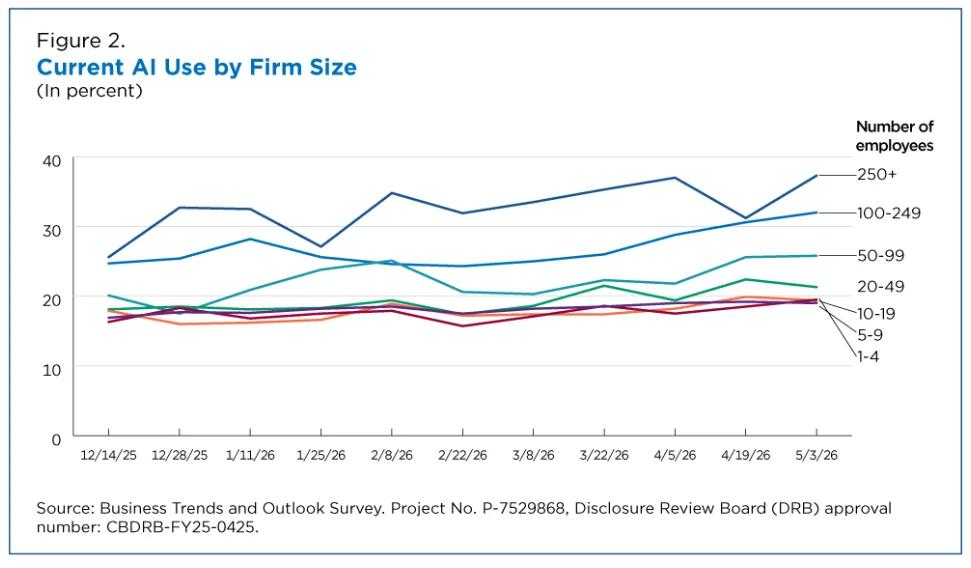
- During the two weeks ending 3 May 2026, 19.8% of US employer businesses reported using AI. (US Census Bureau)
How many business calls get answered
No single dataset includes every business, and the way a missed call is counted varies from one source to another. The biggest publicly available set is from Invoca, which monitors calls for its customers. In 70 million calls, 56% were answered by a person. That percentage is lowered by misdials and rapid hang-ups, so Invoca also reports the share for calls lasting more than 15 seconds (65%) and more than 30 seconds (71%). (Invoca, July 2026)

For home services, a live person takes 52% of calls, 65% of calls that last more than 15 seconds, and 73% of calls that exceed 30 seconds. There is substantial variation across the trades: Invoca reports a span from 32% to 74%, and our contractors guide maps out each trade. (Invoca, home services, July 2026)
- Small businesses: According to CallRail's review of 1.1 million leads from small businesses, missed calls accounted for 32% in healthcare, 28% in legal, 14% in home services and 9% in real estate. (CallRail, 15 January 2025)
- Law firms: A research company engaged by Clio reached out to 500 law firms with a client inquiry. Its mystery shoppers managed to contact 52% of the firms by phone, but just 40% answered when called, and 48% remained unreachable by phone even after messages were left; 33% replied to an email. (Clio, 2024 Legal Trends Report)
The numbers vary for several reasons. Invoca counts a call as answered only when a person picks up, so voicemail and phone menus are treated as unanswered. CallRail's release does not specify what counts as a missed call. Clio's shoppers submitted one inquiry for each firm. Invoca mainly serves larger companies that monitor marketing calls, whereas CallRail focuses on small businesses. All three sell software for answering, tracking or managing calls.
When calls come in
Phone traffic does not end when the workday does. Looking at ServiceTitan data covering May 2025 through July 2026, trades companies received between 10.7% and 12.1% of their calls after hours, with the highest share occurring from May to July. Businesses employing 1 to 10 technicians saw 11.8% of their calls come in outside business hours, compared with 15.7% for firms with 50 or more. (ServiceTitan, 22 October 2026)
Seasonality also plays a role. In June 2025, 14.1% of calls to residential HVAC shops came outside weekday business hours (8 a.m. to 5 p.m.), compared with 9.8% in October. (ServiceTitan, 3 June 2026)
NextPhone, which provides an AI receptionist for small businesses, primarily law firms plus home and local service companies, reported that 14.1% of incoming calls come in outside normal hours: 7.4% during weekends and 6.6% in weekday evenings and early mornings. Those after-hours calls were more likely to become a lead or a booking than calls placed during business hours, at 23.6% versus 18.6%, and the week's peak calling hour was Monday at 11 a.m. (NextPhone, 27 October 2026)
Law firms receive a larger share of these: in Smith.ai's review of over three million law firm calls, roughly one in five arrived outside regular business hours. (Smith.ai, via LawSites, 16 October 2026)
Every company defines business hours differently. In ServiceTitan's HVAC study, the window is Monday through Friday, 8 a.m. to 5 p.m.; for NextPhone, it is Monday through Friday, 8 a.m. to 6 p.m. Our after-hours answering guide explains who handles those calls.
What callers do after a missed call
The majority of people who get sent to voicemail end the call. Across more than 18 million missed calls on Quo's phone system from July to September 2026, just 15% of callers actually left a voicemail: 16% while business hours were in effect and 14% outside those hours. By sector, the share ranged from 10% in air freight and logistics to 24% in technology hardware, while legal services stood at 18% and both real estate and home services were at 16%. (Quo, 2 November 2026)

Questionnaires capture what people report doing, and those reported rates tend to be higher. In CallRail's survey of 1,000 US consumers, 42% said they leave a voicemail when a business doesn't answer, 24% said they turn to online chat instead, and 21% said they immediately call another business; 78% said they had given up on a business after an unanswered call. By contrast, Invoca's 2024 platform data shows the opposite end of the spectrum: fewer than 3% of home-services callers sent to voicemail left a message. (CallRail, 25 September 2025; Invoca, 23 May 2024)
Why callbacks fail
Returning calls by itself does not eliminate the shortfall. Quo examined 16.7 million missed calls in its system and defined a callback as any call placed by the business to the caller's number within 48 hours: 69% received no return call. Among the 31% that did get called back, almost all were reached within 24 hours. (Quo, 20 August 2026)
When businesses return calls, the person being called often fails to answer. In a Pew Research Center survey of 10,211 US adults conducted in July 2020, 80% said they usually do not pick up calls from unfamiliar numbers: 67% allow the call to go to voicemail and then review it, while 14% also disregard the voicemail. Just 19% said they typically answer. (Pew Research Center, 14 December 2020)
Robocalls are a large part of the cause. In Hiya's 2026 survey of more than 12,000 consumers across six countries, 86% reported that they do not pick up calls from unknown numbers, while 73% said businesses ought to identify themselves through caller ID. On average, Americans now receive 9.9 unwanted calls each week, and YouMail estimates that US consumers got more than 4 billion robocalls in October 2026, or roughly 129.8 million per day. (Hiya; Hiya, 2 March 2026; YouMail, 10 November 2026)
Use a phone number the caller already knows, like your business line, to return the call, and then immediately send a text after the missed call so you can reach people who do not answer; our missed call text back guide explains the tools and the texting rules.
How fast to respond
In hiring, speed can make all the difference. A 2026 Management Science study examined over 11.6 million messages exchanged between buyers and sellers on Fiverr and found that waiting one hour before responding was associated with a 46% lower likelihood of getting hired, while a one-day lag corresponded to about a 90% lower likelihood. The analysis covered written communication on a freelance marketplace rather than phone conversations. (VanEpps, Hart, Sezer and Amir, Management Science; Vanderbilt, 23 July 2026)
Most customers anticipate a quick response, yet only about a third receive one. In Invoca's survey of 693 US consumers in May 2026, 56% said they expected a reply within an hour after submitting a form, while just 36% received that response; 79% reported they would move to a competitor that answers more quickly. (Invoca, 9 June 2026)
Owners of home-service businesses are familiar with this: in a December 2025 Jobber survey of 1,050 US home-service business owners, 60% reported responding to leads on the same day, while 20% did so within an hour. (Jobber)
What an answered call is worth
Money comes through answered calls. According to Invoca's 2026 data, 38% of answered calls from digital marketing were sales leads, and 42% of those leads turned into conversions during the call; for home services, the figure was 45%. Even so, 55% of home-services businesses failed to ask the caller to purchase or schedule the job. (Invoca; Invoca, home services)
Calls coming from newer channels look even stronger: among the calls Invoca tracked, those referred by ChatGPT produced the highest lead rate at 49%, surpassing Google Business Profiles, which came in at 43%. (Invoca, July 2026)
Larger offices book a greater share of their incoming calls. According to ServiceTitan's data for May 2025 through July 2026, shops with 1 to 10 technicians booked 30% of calls, those with 11 to 24 technicians booked 42%, those with 25 to 49 technicians booked 52%, and those with 50 or more technicians booked 58%. (ServiceTitan, 22 October 2026)
AI and after-hours answering
AI is still the exception among small businesses. According to the Census Bureau's Business Trends and Outlook Survey, as of 3 May 2026, 19.8% of US employer businesses reported using AI during the prior two weeks, and the share was below 20% for firms with four or fewer employees. By contrast, 37% of companies with at least 250 employees said they did. (US Census Bureau, 22 May 2026)
Contractors see after-hours coverage as a reason to give it a try. In ServiceTitan's survey of 1,017 US contractors conducted from May to June 2026, the hiring shortfall ranked first as the reason for testing AI, at 37%, with off-hours support next at 34%. Just 11% said they trusted their AI tools highly or completely, while 58% reported little or no trust. (ServiceTitan, 29 September 2026)
People are divided about speaking with a machine. Housecall Pro found that 53% of homeowners said they are at ease with AI managing first-contact inquiries (1,040 homeowners, October 2025). Meanwhile, in Invoca's May 2026 survey, 59% of US consumers chose a human when both options were equally accessible, and 83% said it is important for a brand's AI to disclose that it is AI; our AI receptionist laws guide explains where this is required by law. (Housecall Pro; Invoca)
In Scorpion's late-2025 surveys with Dynata, the results showed that homeowners are seeking a response outside normal business hours: 56% of 2,000 homeowners said they wanted 24/7 scheduling or another way to reach someone after hours, while 66% of 944 home-services businesses identified after-hours customer service as their biggest challenge. (Scorpion, 19 February 2026)
100 calls, followed through
Combine two of these datasets and track 100 calls to a home-services company. Using Invoca's rates, 52 calls are answered by a person; roughly 20 of those become leads, and about 9 of those are booked during the call. For the 48 calls that go unanswered, Quo's 16% voicemail rate for home services results in about 8 messages, while around 40 calls finish with neither a conversation nor a message.

Count your own missed calls
All phone systems record unanswered calls. Over the span of one month, tally them:
- Calls received, calls picked up, and calls that were sent to voicemail, taken from your phone system's call log or report.
- Calls placed beyond your business hours, expressed as a portion of the whole, compared with the 11% to 14% range above.
- Voicemails left, compared with calls missed.
- Missed calls you returned within 48 hours, which is how Quo defines a callback.
- If the same customer phones three times, that still counts as one individual, not three separate leads.
Next, assign them a value. Below is the calculation for a home-services company receiving 100 calls each month, based on the published rates; replace these figures with your own.
| Step | Roughly, a month | Rate used |
|---|---|---|
| Calls | 100 | Your own count |
| Missed | 14 to 35 | 14% (CallRail) to 35% of calls over 15 seconds (Invoca) |
| Leads among them | 5 to 13 | 38% (Invoca) |
| Jobs if answered | 2 to 6 | 45% of leads (Invoca) |
| Revenue at stake | $2,900 to $7,200 | $1,205 a job (Housecall Pro, HVAC repairs, 2025) |
It presumes that callers who do not get connected are just as likely to become leads and to schedule as those who reach someone, and it measures revenue rather than profit. Because Invoca's and CallRail's customer bases are different, the low and high ends of the range are drawn from separate datasets.
When the figure climbs into the thousands, compare it with the monthly cost of an answering service or an AI receptionist. Our AI receptionist cost guide prices them according to your volume, and our missed call text back guide explains a low-cost remedy.
Famous numbers we checked
These numbers are cited in many places. When we searched for the original study, this is what we discovered:
- "62% of calls to small businesses go unanswered." According to 411 Locals, this figure dates to January 2016. The study tracked the calls of 85 businesses over a 30-day period; 37.8% of the calls were answered, 37.8% reached voicemail, and 24.3% received no reply. It is a ten-year-old study involving 85 businesses, and no call count was provided. (411 Locals, 18 January 2016)
- "85% of people whose calls go unanswered won't call back." We could not locate any study supporting this; the citation trail stops with blog posts referencing one another.
- "80% of callers sent to voicemail don't leave a message." The earliest reference we located is a November 2014 CRM magazine article, which cites Forbes magazine but names no study. The current figure is Quo's 15% rate measured in 2026, noted above. (CRM magazine, 1 November 2014)
- "75% of callers won't leave a voicemail." The nearest source is an answering-service CEO's estimate, given in the same 2014 article, that the figure falls between 50% and 75%.
We omitted all four from the figures shown above. If you cite them, include both the date and the method as well.
Questions business owners ask
What percentage of business calls go unanswered?
Invoca's 2026 analysis of 70 million calls shows that roughly 44% of business calls are never picked up by a person, while 35% of calls lasting more than 15 seconds go unanswered as well. In separate small-business figures from CallRail, missed-call rates are reported at 9% for real estate, 14% for home services, 28% for legal and 32% for healthcare.
How many callers leave a voicemail?
Roughly 15%. Quo analyzed it using over 18 million missed calls from July through September 2026: 16% in business hours and 14% outside business hours, with industry figures ranging from 10% to 24%. In surveys, 42% of consumers report leaving one.
How many missed calls get a callback?
According to Quo's data on 16.7 million missed calls, 31% received a callback; 69% did not hear back from the business within 48 hours, and almost every callback that occurred was made within 24 hours.
How many calls come in after hours?
Approximately 1 in 8 for trades businesses (10.7% to 12.1% in ServiceTitan's data from May 2025 to July 2026), 14.1% among the small businesses using NextPhone's AI receptionist, and about 1 in 5 for law firms in Smith.ai's data.
Is the “85% of callers won't call back” statistic real?
We were unable to locate a study supporting it; instead, the claim is echoed across blog posts that reference one another. The available numbers concern voicemails and callbacks: just 15% of callers leave a voicemail, and 69% of missed calls receive no callback from the business within 48 hours (Quo, 2026).
How do I work out what missed calls cost my business?
Take your missed calls, multiply them by the proportion that turn into leads and by the fraction of leads you schedule, and then multiply the result by your average job value. Using Invoca's home-services figures (38% leads, 45% booked on the call) and a $1,205 job value, Housecall Pro's 2025 average for HVAC repairs, 20 missed calls per month come out to roughly $4,100 in revenue.
Sources
- Invoca, 7 Insights From Analyzing 70 Million Phone Conversations: 2026 Report (13 July 2026); Home Services Lead Conversion Benchmarks Report 2026 (July 2026); See How Much Missed Sales Calls Cost Home Services Businesses (23 May 2024); consumer survey of 693 US respondents, 8 to 22 May 2026 (press release, 9 June 2026)
- CallRail, report benchmarking marketing for small businesses (1.1 million leads, 15 January 2025); Why businesses can't afford to miss calls (survey of 1,000 US consumers, 25 September 2025)
- Clio, client intake findings of the 2024 Legal Trends Report (secret shop of 500 law firms)
- Quo, Why only 15% of callers leave a voicemail (more than 18 million missed calls, July to September 2026; 2 November 2026); Small business callback statistics in 2026 (16.7 million missed calls; 20 August 2026)
- ServiceTitan, Trades Industry Trends: Call Booking, Close Rates and Off-Hours Calls (May 2025 to July 2026; 22 October 2026); When Summer Demand Spikes, After-Hours Calls Do Too (3 June 2026); contractor AI survey with Thrive Analytics (1,017 contractors; 29 September 2026)
- NextPhone, The Comprehensive 2026 AI Receptionist Call Report (27 October 2026); Smith.ai, New Data From 3.2 Million Law Firm Calls (LawSites, 16 October 2026)
- Pew Research Center, Most Americans don't answer cellphone calls from unknown numbers (10,211 US adults, July 2020; 14 December 2020)
- Hiya, State of the Call 2026 (more than 12,000 consumers in six countries; 2 March 2026) and Eroding trust is crippling the voice channel; YouMail Robocall Index, October 2026 release (10 November 2026)
- VanEpps, Hart, Sezer and Amir, Speed Is a Signal: When Faster Replies Increase Hiring Likelihood, Management Science (2026), and Vanderbilt Business summary (23 July 2026)
- Jobber, 2026 Home Service Trends Report (1,050 US home-service business owners, December 2025)
- US Census Bureau, Large Firms With at Least 20 Employees Biggest AI Users (Business Trends and Outlook Survey, December 2025 to May 2026; revised 22 May 2026)
- Housecall Pro, Home Service Customer Service Report (1,040 US homeowners, 23 October 2025) and Trades Pulse: HVAC Repair Economics (2026); Scorpion, 2026 State of Home Services Marketing Report (19 February 2026)
- 411 Locals, Small Business Owners Don't Answer 62% Of Phone Calls (18 January 2016); CRM magazine, Business Voicemail Goes Unanswered (1 November 2014)
- Every figure was taken from the original pages on 22 November 2026. The bulk of the call data originates with vendors that provide phone, call-tracking or answering software; each line above names who measured it and how. How we work