How much does a receptionist cost? Pay, payroll taxes and benefits, by state
For a small business, employing a full-time receptionist at the US median wage comes to roughly $47,343 annually, or $3,945 each month, after adding payroll taxes, insurance, retirement, and bonus pay to the $38,010 salary. Below: how those dollars are allocated, the cost in each state, a part-time receptionist, and the number of hours you actually get for that cost.
For May 2025, the Bureau of Labor Statistics reports a median receptionist wage of $38,010 per year, which works out to $18.27 per hour. However, that figure reflects wages alone. In addition, employers must cover Social Security and Medicare taxes, unemployment insurance, and workers’ compensation, and they typically provide some health insurance, retirement contributions, and bonus pay. Using the BLS employer cost survey for June 2026, we took what small private employers actually pay beyond wages and then applied those figures to the receptionist wage in each state. This produces the total annual cost of the position, rather than just the paycheck. (BLS OEWS, May 2025; BLS ECEC, June 2026)
- Median pay
- $38,010 a year ($18.27 an hour), May 2025
- Middle half of receptionists
- $33,960 to $45,130 a year
- Full cost at a small business
- about $47,343 a year ($3,945 a month)
- Hours at the desk
- about 1,919 a year, 22% of all hours
- Cost per hour at the desk
- about $24.67
- Cheapest and dearest
- Mississippi $38,811; District of Columbia $61,106
What you pay on top of the wage
Pay makes up the largest share of the bill. Based on the BLS survey of employer costs for June 2026, for each $100 that a business with fewer than 50 workers spends on wages and paid time off, it pays roughly $24.55 more for payroll taxes, insurance, retirement, and bonus pay. For the median receptionist earning $38,010, that comes to about $9,333 per year. (BLS ECEC, Table 6)

Social Security and Medicare are mandated by federal law and remain uniform across all states: employers contribute 6.2% and 1.45% of wages, and the 2026 Social Security wage base of $184,500 is well above a receptionist’s pay. Federal unemployment tax equals 6.0% on the first $7,000 of each employee’s wages, or 0.6% ($42) once the state unemployment tax credit is applied, with a higher amount in states subject to a credit reduction. By contrast, state unemployment tax and workers’ compensation rates vary according to both the state and the employer. (IRS Topic 751; IRS Topic 759)
Paid leave does not appear in the list because the BLS annual wage already accounts for it: the figure equals the hourly rate multiplied by 2,080 hours, which represents a full year including paid holidays and vacation. Larger workplaces devote a greater share to benefits: 33.0% of total compensation at establishments with 100 or more workers, compared with 25.9% at those with fewer than 50. (BLS OEWS; BLS ECEC, Table 6)
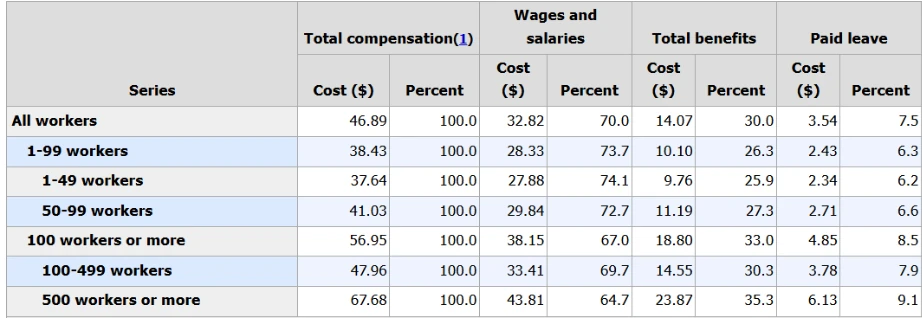
These figures represent averages across all types of positions at small private employers, rather than receptionists by themselves. A business that pays for a receptionist’s health insurance is likely to spend more than this average, and one that provides no insurance at all will spend less. Using the averages for office and administrative support roles at employers of all sizes instead, the total annual cost is roughly $49,879. (BLS ECEC, Table 4)
Receptionist cost by state
Receptionist wages range from a median annual figure of $31,160 in Mississippi up to $49,060 in the District of Columbia. When the same small-employer expenses are included, the total annual cost extends from roughly $38,811 in Mississippi to $61,106 in Washington, DC. Of the states, Alaska ($55,700) and Washington ($55,688) are the most expensive.

| State | Median pay | Full yearly cost |
|---|---|---|
| Alabama | $32,590 | $40,592 |
| Alaska | $44,720 | $55,700 |
| Arizona | $38,730 | $48,239 |
| Arkansas | $34,840 | $43,394 |
| California | $44,100 | $54,928 |
| Colorado | $42,010 | $52,325 |
| Connecticut | $40,630 | $50,606 |
| Delaware | $36,310 | $45,225 |
| District of Columbia | $49,060 | $61,106 |
| Florida | $36,810 | $45,848 |
| Georgia | $36,100 | $44,964 |
| Hawaii | $41,600 | $51,814 |
| Idaho | $36,810 | $45,848 |
| Illinois | $37,400 | $46,583 |
| Indiana | $36,160 | $45,038 |
| Iowa | $37,330 | $46,496 |
| Kansas | $36,050 | $44,901 |
| Kentucky | $32,940 | $41,028 |
| Louisiana | $32,750 | $40,791 |
| Maine | $42,440 | $52,860 |
| Maryland | $38,100 | $47,455 |
| Massachusetts | $43,870 | $54,642 |
| Michigan | $37,470 | $46,670 |
| Minnesota | $37,510 | $46,720 |
| Mississippi | $31,160 | $38,811 |
| Missouri | $35,740 | $44,515 |
| Montana | $37,360 | $46,533 |
| Nebraska | $37,860 | $47,156 |
| Nevada | $37,050 | $46,147 |
| New Hampshire | $38,160 | $47,530 |
| New Jersey | $41,650 | $51,876 |
| New Mexico | $35,140 | $43,768 |
| New York | $43,080 | $53,658 |
| North Carolina | $35,440 | $44,142 |
| North Dakota | $39,530 | $49,236 |
| Ohio | $35,920 | $44,740 |
| Oklahoma | $34,560 | $43,046 |
| Oregon | $40,900 | $50,942 |
| Pennsylvania | $36,810 | $45,848 |
| Rhode Island | $42,620 | $53,085 |
| South Carolina | $35,510 | $44,229 |
| South Dakota | $38,280 | $47,679 |
| Tennessee | $34,910 | $43,482 |
| Texas | $35,210 | $43,855 |
| Utah | $36,960 | $46,035 |
| Vermont | $38,370 | $47,791 |
| Virginia | $37,060 | $46,159 |
| Washington | $44,710 | $55,688 |
| West Virginia | $31,920 | $39,757 |
| Wisconsin | $41,150 | $51,254 |
| Wyoming | $37,480 | $46,683 |
BLS median annual pay, May 2025, is the hourly median multiplied by 2,080 hours. The full cost then adds 24.55% to cover payroll taxes, insurance, retirement, and bonus pay, using the June 2026 average for private establishments with fewer than 50 workers. Because state taxes and benefit expenses differ, regard the full cost as an approximation.
The hours you get for it
A full-time receptionist is paid for 2,080 hours a year. For small employers, paid leave expenses amount to 8.4% of wages tied to hours worked, which works out to roughly 161 hours of paid time off, or 20 workdays. That leaves around 1,919 hours at the desk, equal to 22% of the 8,760 hours in a year. Additional reductions come from breaks, sick days exceeding paid leave, and the weeks required to refill the position after an employee departs.
Even if a business has a receptionist, it still requires a call-handling plan for lunchtime, after hours, and weekends. Measured only over the time spent at the desk, the median receptionist costs about $24.67 per hour. Our after-hours answering guide covers the calls that come in when nobody is at the desk.
A part-time receptionist
Benefit expenses are lower for part-time employees. In private industry in June 2026, benefits accounted for 20.0% of part-time workers’ total compensation, compared with 31.5% for full-time workers. A receptionist earning the median wage of $18.27 per hour and working 20 hours each week would make roughly $19,001 annually. After including part-time benefit costs, the employer’s annual outlay is about $22,747, which works out to $1,896 per month, for 20 of the 168 hours in a week. (BLS ECEC, Table 5)
Receptionist, answering service or AI receptionist
In addition to fielding calls, a receptionist welcomes and checks in visitors, arranges appointments, organizes paperwork, and manages mail, according to the BLS; therefore, an answering service covers only a portion of the role. For the telephone portion, the following shows the cost of 200 two-minute calls per month on the published plans we monitor, compared with $3,945 a month for a full-time receptionist: (BLS Occupational Outlook Handbook)

At that call volume, live answering services run from $575 to $1,965 per month, while AI receptionists cost $59 to $385; both provide 24/7 coverage, including the 78% of the year when a receptionist is off duty. Even so, a human is still better at dealing with visitors and atypical requests, so many companies combine the two: a receptionist during the day plus an answering service or an AI receptionist for overflow, lunch breaks, and after-hours coverage.
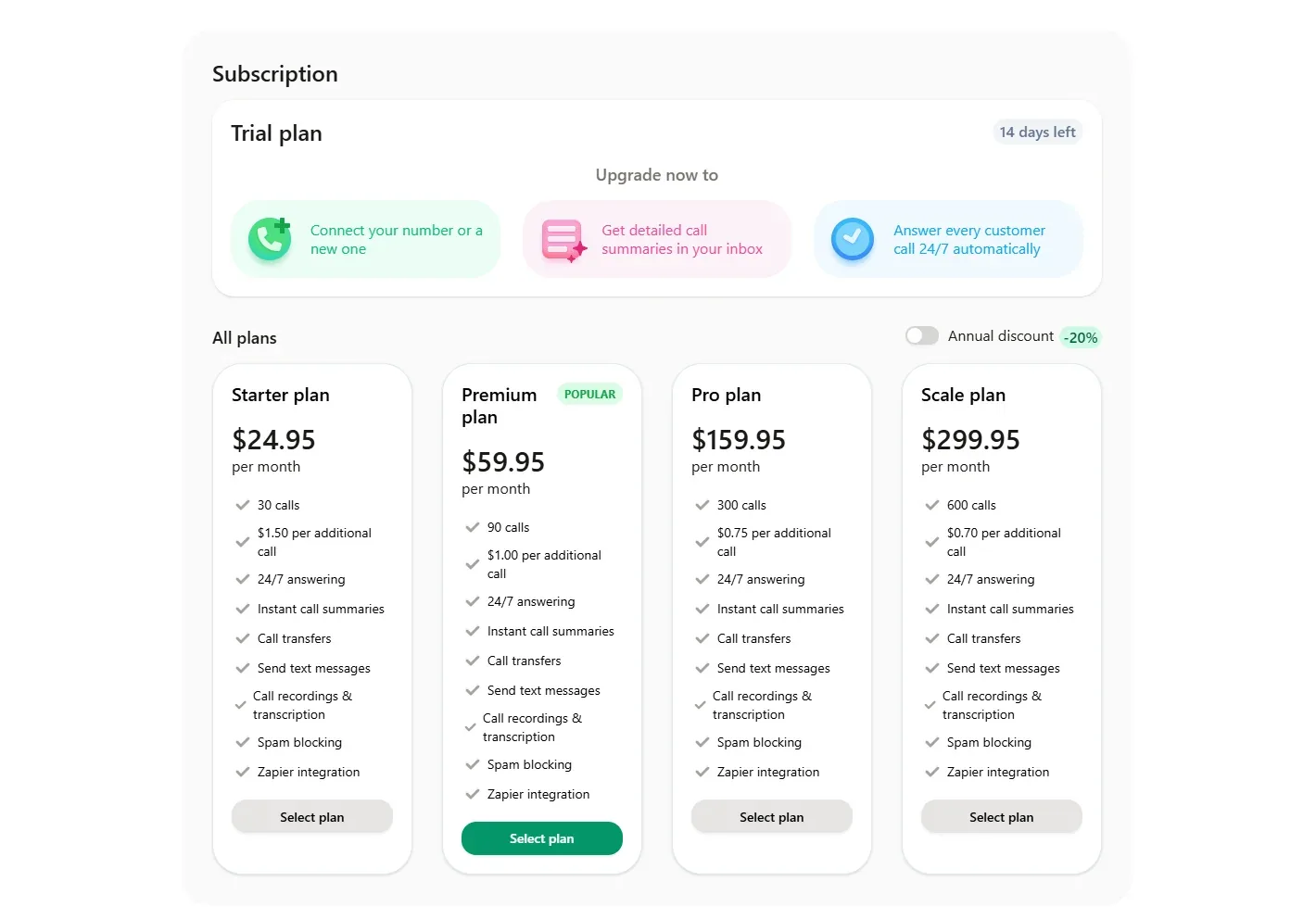
At your call volume, our AI receptionist cost guide prices each AI service, and the virtual receptionist guide prices the live services the same way.
How we calculated it
- Pay: BLS Occupational Employment and Wage Statistics, May 2025, receptionists and information clerks (43-4171), median annual earnings by state, obtained from the OEWS Query System on 21 November 2026. The BLS annual amount equals the hourly wage multiplied by 2,080 hours, so paid time off is included; overtime premiums, shift differentials, and bonuses are excluded. (OEWS Query System)
- Beyond wages: according to BLS Employer Costs for Employee Compensation, June 2026, Table 6, for private establishments employing 1 to 49 workers, the figures per hour worked are $27.88 for wages, $2.34 for paid leave, and $7.42 combined for supplemental pay, insurance, retirement, and legally required benefits. When $7.42 is divided by $30.22, which is $27.88 plus $2.34, the result is 24.55%, and that share is added to the annual wage. (Table 6)
- Hours: at a paid-leave rate of $2.34 per $27.88 in wages, the share is 8.39%, which means 2,080 paid hours correspond to roughly 1,919 hours of work (2,080 divided by 1.0839).
- Part-time: in Table 5, employers paid private-industry part-time workers $20.15 in wages, $0.90 in paid leave and $4.15 in other benefits for each hour worked, which amounts to 19.71% added to pay. (Table 5)
- Limits: the survey averages cover all occupations at small private establishments, and the actual expenses vary according to the benefits provided, the state unemployment tax rate, and workers’ compensation premiums. The BLS receptionist category also includes information clerks.
Questions owners ask
How much does a receptionist cost per year?
For a small business, a receptionist at the US median wage costs about $47,343 a year: $38,010 in wages plus roughly $9,333 for payroll taxes, insurance, retirement, and bonus pay (BLS pay for May 2025 and employer costs for June 2026). Across states, the amount ranges from about $38,811 in Mississippi to $61,106 in Washington, DC.
How much does a receptionist cost per hour?
The median wage comes to $18.27 per hour. After adding payroll taxes and benefits, a full-time receptionist costs roughly $22.76 for each paid hour ($47,343 divided by 2,080), or about $24.67 per hour actually spent at the desk once paid leave is excluded.
How much does a part-time receptionist cost?
With a 20-hour workweek and the median wage of $18.27 per hour, that comes to roughly $19,001 in pay and $22,747 a year in total, or $1,896 each month, based on the BLS part-time benefit costs for private industry.
What payroll taxes does an employer pay for a receptionist?
Social Security is 6.2% of all wages, with the $184,500 cap applying in 2026, and Medicare is 1.45%. Federal unemployment tax is 0.6% on the first $7,000, or $42, after the state unemployment tax credit is taken into account. For $38,010 in wages, that works out to roughly $2,950, not including state unemployment tax or workers’ compensation, both of which differ from state to state.
Is an answering service cheaper than a receptionist?
Yes, for answering the phone. With 200 two-minute calls per month, live answering services run from $575 to $1,965, while AI receptionists range from $59 to $385 on their published plans; by comparison, a full-time receptionist costs about $3,945 per month once taxes and benefits are included. In addition, a receptionist can manage visitors and other office tasks, something a phone service cannot do.
Sources
- US Bureau of Labor Statistics, Occupational Employment and Wage Statistics, May 2025, receptionists and information clerks (43-4171): occupation profile and OEWS Query System (state figures taken 21 November 2026)
- US Bureau of Labor Statistics, Employer Costs for Employee Compensation, June 2026: Table 4, by occupational group, Table 5, by work status and Table 6, by establishment size, read 21 November 2026
- US Bureau of Labor Statistics, Occupational Outlook Handbook: Receptionists, read 21 November 2026
- IRS, Topic no. 751, Social Security and Medicare withholding rates and Topic no. 759, Form 940 (FUTA), both reviewed 9 November 2026
- Answering service and AI receptionist prices: the published plans in our AI receptionist cost guide and virtual receptionist guide, checked 21 October 2026; Upfirst pricing, read 21 November 2026, and our own Upfirst trial account (16 October 2026)